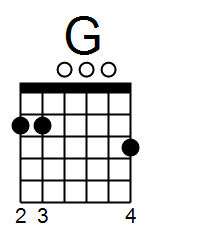
Note entry by keyboard is usually highly inefficient in score editing programs, and MuseScore is no exception.
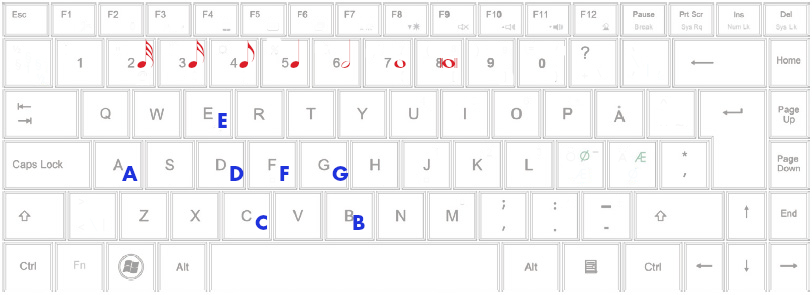
By default, notes are entered with the corresponding letter keys (c=c, d=d, etc.), whose placement on the keyboard does no follow any muscial logic. Incidentally, all the note names are placed on the left-hand side of the keyboard, but in no systematic order. The rhythmic values are typed in with the number keys, way up on the top line of the keyboard. This means that all the keys you would use for inputting music happen to lie on the left-hand side, so even if you’re an exceptionally skilled typist, entering music is unnecessarily slow, since you would end up jumping around senselessly with your the left hand:
The default keys for entering pitches and rhythm values in Musescore.
My Way
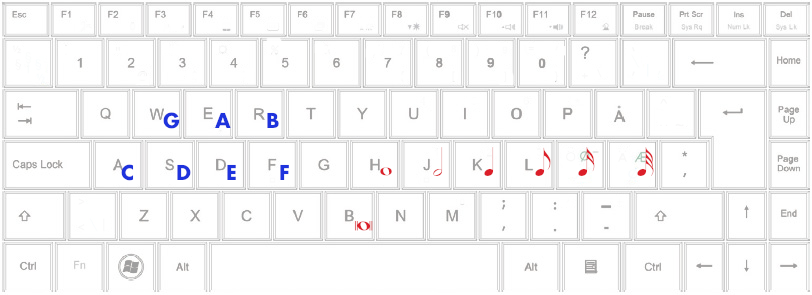
I use a different layout, which makes it possible to “play” on the keyboard more like a piano keyboard, all on the home row or the adjacent rows. No jumping around.
Note entry is done with the left hand, rhythms with the right:
My revised layout
The layout is based on the principle that music frequently moves by step, so having adjacent notes next to each other is a good thing. Also, fourths are common, so it is not unnatural to have d and g on the same finger.
The remapping therefore follows the scale and disregards the ordinary letters on the keys.
Similarly, rhythmic changes more often than not go to adjacent values, and the most frequent values are placed at the main positions of the hand.
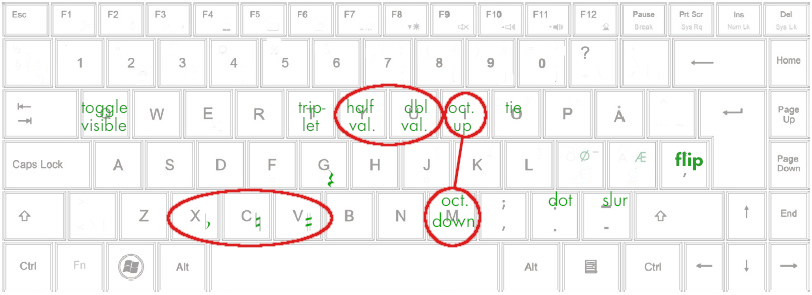
The remaining keys are mapped to common functions: rest (g, next to the notes), triplet (t), double/half time (y, u), octave up/down (i,m), flat/natural/sharp (x,c,v), dot (.), tie/slur (o,-); “q” (quiet) for “Toggle visible”:
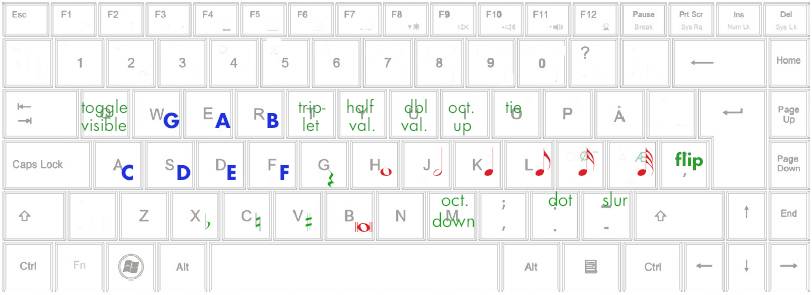
All in all: a complete keyboard layout that is optimal for note input:
There are other shortcuts as well, which have nothing to do with the input system itself, so I won’t go into them. See the config files below for details.
What remains?
Thanks for asking. There are a couple of features that I would have liked to implement, which are not possible (yet!) because of missing keyboard shortcuts in MuseScore’s current layout, as well as bad application choices more fundamentally.
I would e.g. have loved to have a key for “input dynamic” (e.g. p for “mezzo piano”), and then increase or decrease the value, going stepwise through the dynamics (so that repeated presses would go through p, pp, ppp etc. in one direction and mf, ff, fff, etc. in the other).
Likewise, it would have been great to be able to cycle through the accidentals within the currently selected pitch (so: adouble-flat, aflat, a, asharp, adouble-sharp), rather than having Musescore decide/guess for you whether you want a a flat or a g sharp, or even worse: an a double-flat or an f double-sharp.
Downloads
Here are my keyboard shortcuts. To try them out, save the file, then go to Edit > Preferences > Shortcuts > Load …. and select the file that you downloaded.
Note that these files are based on the Norwegian keyboard layout. Adjust the keys in the rightmost area of the keyboard according to your own keyboard.
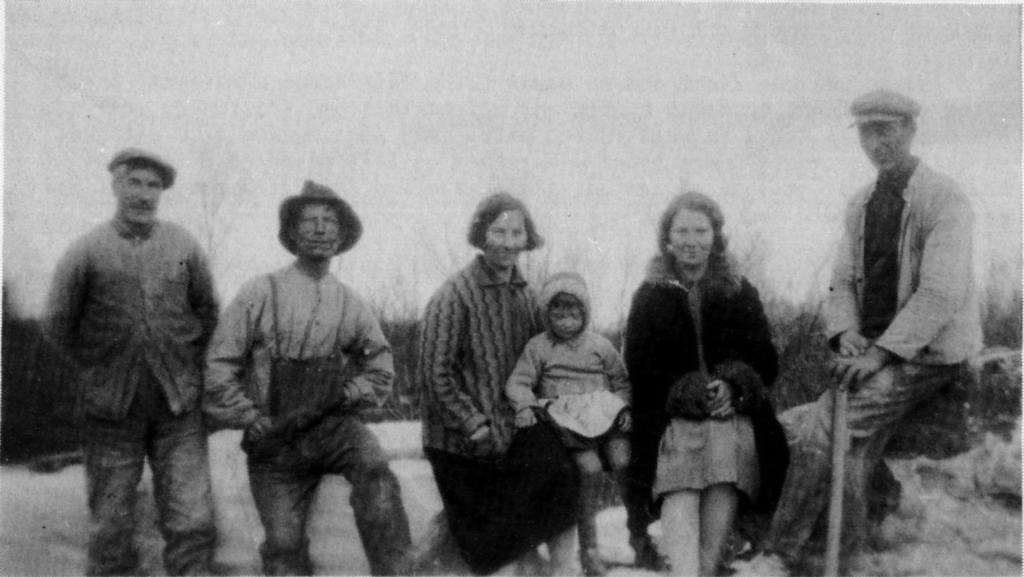
Gjestetekst skrevet av min far, til “Vi Gjækk”, en slektskrønike som ble utgitt til min farfars 100-årsjubileum i 1987. Farfar er nummer to fra venstre på bildet.
Far min drog til Brettesnes og Syltefjord der fisken var. Lenger ut i verda kunne han ikkje kome. Som vegarbeidar måtte han først byggje vegen vi trengte for å kome oss vidare ut i verda.
Ein dag i Amsterdam kryssa eg ei fæl gate med fare for mitt liv. Den byen har ikkje trafikkultur, ein fotgjengar har låg pris. Når bilane stoggar for raudt lys, vrimlar det av syklistar – i fotgjengarfeltet. Det var eit kav å kome seg over gata, summe seg og finne ut om ein framleis var i live og kor ein i så fall tilbragte dette liv. Blikket opp mot gateskiltet fortalte meg det: JOHAN HUIZINGASTRAAT stod det.
Då tenkte eg på far min. Det var ein typisk assosiasjon, eit tankesamband utan logikk, utan samanheng med situasjonen. Det kom ein tanke seglande med eit namn, annleis var det ikkje.
Samanhengen mellom Huizinga og far min må eg vente med til eg først har fortalt kva for bilete som stod og dirra i medvetet då eg såg dette rare namnet.
Far er eit diffust minne, eg må vri og vrenge på dette minnet for å hente han fram. I dei åtte åra eg fekk til å hente røynsler og danne bilete av han, var han mest bortreist, og minnet avgrensar seg til at han kom og drog att. Små glimt blir likevel ein heilskap. Eg veit at denne heilskapen er feil, glimta blir lappa saman i feil rekkefølgje, hendingar med års mellomrom blir til samanhengande dagshendingar. Difor blir mitt unge minne reinspika løgn. Men for meg blir minnet sant, og dette er mi sanne historie:
Far arbeidde på Senja, på ein stad der dei slit og strevar hardt og stønner under tunge tak, difor kalte dei staden Stønnebotn, Dei store sa: i dag kjem han pappa. Så var det å finne seg ein plass i loftsvindauget eller pirke seg eit hol i den svarte pappen som tyskarane påla oss å spikre over vindauga i stua – og vente. Vente på ein prikk langt ute i fjorden, prikken som blei større og slørre inntil han blei båt, ein mann og så til slutt ein levande pappa som kom opp bakkane.
Inn på kjøkenet, av med grå ryggsekk som aldri inneheldt overraskingar, berre ei spesiell lukt som enno sit i nasen, sur, søt, ram, deilig. Lukt av furukvae, lyng, krutt og sveitt mann. Skikkeleg pappalukt, Mor sa:
– Korsen kom du deg over Senja?
– Eg gjækk.
– Kem sin båt har du?
– Brandvollan sin.
Så åt han. Så gjekk han i åkeren. Han låg på kne, han låg alltid på kne i åkeren. Same kva andre seier: Det er heilt sant at han heile sitt gardbrukarliv låg på kne i åkeren, for det står i mi sanne historie.
Vi blei sendt på loftet. Det var sengetid, det var mørkt. Frå loftsvindauget såg vi han i åkeren, på kne. Før vi somna, pirka vi vekk nokre bord som låg laust over eit hol mellom loft og kjøken og keik ned for å sjå om han var komen inn, men har var der ikkje. Då vi vakna, låg han framleis i åkeren, ein heilt annan stad.
Så kom han inn, fjelga seg, åt og tok på seg ryggsekken. Vi gjekk med han til fjæra, og han rodde. Han blei mindre og mindre, blei prikk. Frå holet mitt i blendingsgardinen studerte eg denne prikken så lenge han var der. Når ein heil båt er så liten som ein muselort, kor liten må ikkje pappa vere då?
Men dette er ikkje heile mi sanne historie, det er berre den ytre ramma. For no kjem vi til underet, det eg måtte heilt til Amsterdam for å forstå. Då vi kravla oss i snørrlivet, ullhosane og genseren neste morgon og kom ned på kjøkenet, hadde mor fått ny grautsleiv. Det var utskjæringar på skaftet, akantusrankar langs heile kanten. Og i lampa – o store vidunder! – hang ein påfugl av spon med struttande vengjer og halefjør!
Det var dette den vaksne i Amsterdam tenkte på. Den vaksne hadde ofte tenkt: Dette må vere eit forvrengt bilete, det må vere mange små glimt som har kokt seg saman for meg. For det kunne ikkje vere mogleg at ein mann kunne gå over Senja, ro Solbergfjorden, gå i åkeren og setje potet til natta tok han og deretter setje seg til å spikke grautsleiv og lage påfuglar i ein og same vending – og deretter vere i åkeren att med dagslyset?
Difor må eg dikte resten av det som skjedde, det eg ikkje med eigne ører og eige syn hørte og såg gjennom loftsluka, men som er like klinkande sant som resten av historia: Då han kom inn mo og matt frå åkeren og tørka jord av hendene, møtte han ein annan slitar som sa:
– Se på dejnna sleiva, de’kje mykje å hjelpe seg med, de’e bære flisen igjen. Du ha’kkje et æmne så du kunnar skorre ei ny?
Og han hadde emne, og han spikka sleiv, like raskt og skikkeleg som snekkar Andersen i jule-eventyret. Han spikka og skar, først tenkt som ei grovhogd og hurtigarbeidd brukssleiv, men så kom det eit nytt signal fra den andre slitaren:
– Bjøllsauen har nån frøktelige klauva. Han sku’ar vorre skorren før vi sleppe han i marka.
Då ho sa det, passerte han ei grense. Ikkje det i tillegg til det andre! Klauvar får vere klauvar. No er det sleiv. Så gjekk han over grensa til det ulovlege. Han finpussa med kniven, han skar og skar, utskjæringar, akantusrankar slynga seg langs skaftet. I ein pause på grunn av tom vassbøtte, tok han turen til Vassholet og henta samstundes ein olderkvist, tok bark i kjeften og tygde til spyttet rann rødt frå kjevane. Så smurte han barkespytt i akantusranken og pussa med kniven.
Så sopte han saman sponene, gløymde bjøllesauen og laga noko kjekt til ungane, ein påfugl med struttande vengjer og halefjør.
Og så slang han seg nedpå for å kvile litt før neste økt i åkeren og roturen tilbake til Senja og veganlegget.
Men eg er attende i Amsterdam, byen som heilt uskuldig er komen inn i historia, bortsett frå at det var dei som ala opp han Huizinga. Det var namnet som laga den lange rekka av assosiasjonar. Eg kjende att karen. Johan Huizinga, filosof kalte han seg fordi han sa og skreiv mykje rart om mennesket og eksistensen. Eg hugsa han fordi han kjempa mot materialismen som livsform, det ville øydeleggje mennesket og kulturen, sa han. Rett nok er mennesket homo sapiens, det tenkande og kloke individ i homo-ætta. Men det er ikkje nok til å kjenneteikne mennesket. Mennesket er noko meir enn berre klokt, det er også homo faber, det skapande individ, meir kreativ enn noko anna individ, til og med betre skapar enn skjura som bygg kunstverk av bjørkekvistar. Men heller ikkje det er den fulle sanninga om mennesket, sa Huizinga. For mennesket er også homo ludens, det leikande individ. Ein kan ikkje vere anten sapiens eller faber eller ludens, ein må vere alt. Utan at desse tre dimensjonane blir sameint i same individ, blir det ikkje eit harmonisk menneske, sa han. Kanskje ikkje det med skjura, men han sa i alle fall at utan homo ludens ville all kulturell utvikling stogge.
Det var det han var, far min, ein utgave av Huizingas harmoniske kulturberar, mannen som ikkje kunne leve med berre stein, jord, fisk, potetåker og ovgrodde saueklauvar. Akantusrankane og påfuglane var ikkje eit vilkårleg påfunn ein sein kveldstime, det var nødvendig. Det var ludens-dimensjonen som nekta å gå til grunne.
Eg stod der i Huizinga Strasse og oppdaga at mi historie kanskje var sann, den var kanskje ikkje kokt saman av barnefantasi og rotete minne. Og sonen til vegarbeidaren og småbrukaren visste der han stod at denne delen av arven er for verdifull til å skusle vekk.
Og eg trur: Då akantusrankane og påfuglen var ferdig, når homo sapiens etter ein kort kvil fekk slippe til att, så fekk nok bjøllesauen klauvane ordna. Det harmoniske menneske ordnar slikt medan ungane glor på sin påfugl, sprudlar over av homo faber og vil sjå korleis ein slik liten fugl ser ut inni.
Men visste Huizinga noko om bjøllesauar? Måtte han ro Solbergfjorden?
Some people think that Bob Dylan is a mediocre or even bad guitar player. Surprisingly, this also includes people who have spent their entire adult life on dylanological idolizing, scrutinizing, and patronizing.
Clinton Heylin checks all the boxes here. In his “Renaissance masterpiece” (at least that’s how he himself thinks of it), Behind the Shades (2000), he writes about the “gorgeous rendition” of ‘Don’t Think Twice’ on the Freewheelin’ album that “it might just have illustrated how good a guitarist Dylan had become, save that it’s Langhorne who provides the faultless accompaniment” (p. 104).
He has repeated this point in just about every book he has written, and in his latest version of the definitive Dylan biography with the sensationalist title The Double Life of Bob Dylan, where the “masterpiece has been restored to its truer self”, it gets another spin:
Although Langhorne later defended Dylan’s guitar-playing – ‘[he] was actually doing some very interesting things with guitar…He wasn’t a virtuoso guitarist, but he had some very creative ideas’ –Dylan struggled with the latter’s guitar part in the studio until Langhorne overdubbed the guitar and saved his blushes, and time. [on the four track session tape, there is no bleed from the vocal on the guitar track, which confirms it was an overdub, presumably over Dylan’s original part’].
Heylin: The Double Life of Bob Dylan. Restless Hungry Feeling (2021)
The only new evidence Heylin produces in his new version of the story is the alleged lack of bleed on the guitar track. This may or may not prove that the track was overdubbed. What it does not prove is that it was played by Langhorne.
What remains through all the iterations of the account, then, is the same old dogma: this is too good to be Dylan playing.
I’ve previously stated – I would say conclusively, and on the basis of solid musical analysis, not dogma – that the only person who could have played that guitar track is Dylan himself. There is nothing in Heylin’s new oeuvre that changes that verdict.
Musical ability explained
In an unrelated thread at Expecting Rain (thanks to TimEdgeworth1 for the video link), I came across another example that might help unmusical writers understand more clearly what kind of a guitar player Dylan is, and what is and what isn’t difficult for him.
It’s a solo acoustic performance of Mama You Been On My Mind, from Beverly, MA on Halloween in 1992:
Mama is a fairly simple song to play; it comes close to a three-chord song, consisting of the simple chords that every guitar player learns during the first weeks of playing. Heck, even Clinton Heylin might be able to play it.
But have a look at the left hand in the clip. the fingers are moving constantly, in ways that would have been extremely difficult to learn or to copy. Not that it is – it is still just the same simple song, most of the time a simple C major chord with embellishments. But there is constant finger movement, and the more you look at it, the more difficult it seems.
And yet: this is exactly how Dylan plays – or played at that point in his touring career – all the time. Most people, even skilled guitarists, would have difficulty playing exactly like that, but for Dylan, it is automated behaviour. He can play this in his sleep, he can play the harmonica at the same time, he can think about an interesting passage in Dostoyevskij or wonder whether he remembered to lock the door before he left this morning – none of that would interfere with his playing.
But put it on a music stand in front of him (assuming he knows how to read music) or tell him step by step what to do (assuming he doesn’t), and he would be helpless. Again: the reason why it works, why it is possible to play what looks very complicated while sorting laundry or playing harmonica, is that some parts are automated and other elements are left to chance. It is idiosyncratic, and it contains element of improvisation.
And put the sheet music in front of the most accomplished studio musician in the world, and it still wouldn’t sound good, because (a) idiosyncratic playing is antithetical to premeditation – there is a huge difference between making a realization of a structure and shaping an exact object from instructions, and (b) while the chord shapes and the picking technique may be the same whoever plays it, the exact execution will be the result of individual style, the importance of which will be stronger precisely because the basics are so basic.
*
The fingerpicking on Don’t Think Twice is perhaps more technically advanced than the flatpicking in this videoclip, but it, too, depends on the same combination of automatization and idiosyncracy to work. Any guitar player can learn to fingerpick at breakneck speed, in a way that would dazzle onlookers and make unmusical biographers think it is impossible. It is not either difficult to add a couple of finesses here and there to make it sound even more impressive, as Dylan does in Don’t Think Twice. We can follow the development of those finesses through the previous versions of the arrangement.
The musically advanced part is the integration of all the things that are going on at the same time – picking, singing, harmonica – into a coherent whole. In Dylan’s case this is accomplished first and foremost through timing and phrasing. That is the art form in which Dylan excels, and it depends on precisely the combination of automatization and individual style that the clip from 1992 exemplifies.
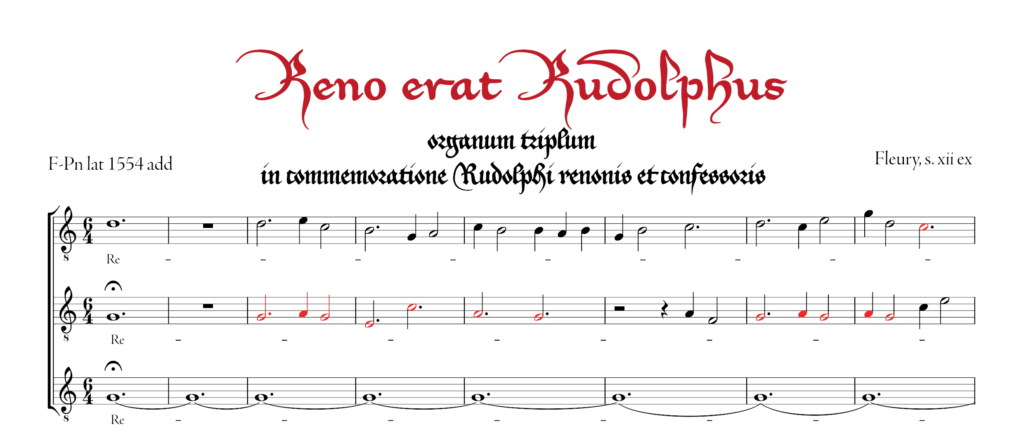
Now, a three-part organum dating from c. 1200 has been unearthed, in a little studied codex from the Notre Dame tradition. It is unlikely that the music is by the Great Perotinus himself, but certain borrowings make it evident that the composer has known the milieu around the Parisian cathedral well.
I am grateful to prof. Mattias Lundberg for drawing my attention to the coat of arms from the Åland archipelago, featured in the video, which clearly demonstrates the widespread celebration of the dear rubrinasal deer during the Middle Ages.
Some Historical Background
The Organum triplumReno erat Rudolphus is in the musical style called Notre Dame organum. It flourished around 1200 in the milieu around the newly-built Notre Dame cathedral in Paris. Most famous today are the two organa quadruplaViderunt omnes and Sederunt principes by the great Perotin.
There has been polyphonic music before his days, but the compositions associated with his name are the first known pieces of music which require a precise notation, since up to four different lines of music have to be coordinated.
Modal rhythm
The notation that was used has been called modal. Where modern notation uses separate symbols to distinguish between different rhythmic values:
modal rhythm indicates rhythms through different groupings of identical symbols:
The sequence of notes is the same, and every note is represented by the same symbol, a square note. The only difference is the groups: in the first example: 3+2+2, giving a long-short pattern; in the second, 2+2+2, which gives the opposite pattern; and in the third, 1+3+3, resulting in the more complex dactylic pattern long-short-short(-but-not-as-short) in the last example.
This is also the mode that is used in the beginning both of Reno erat Rudolphus and of Sederunt Principes. A change to the first mode (long–short) occurs in both compositions after a while.
One may notice that all the patterns are in triple time, and that the last note of each group is long, the others short.
The Song Structure
Notre Dame organum is liturgical music – an embellishment of a plainchant song. Both Reno and Sederunt are Responsories, which means that the whole choir sings the “refrain”, while a soloist sings the verses (usually just a single verse). It is also customary for the soloist to intone the whole song.
This gives the following structure:
Intonation
Respond
Verse
Respond (end)
Solo
Reno erat…
Sanctus Nicholas etc.
Choir
… Rudolphus, nasum rubrum etc.
Omnes tarandri etc.
To this you might object: isn’t it the other way around? Clearly, “Reno erat” is sung by the choir, and the continuation with Rudolphus is just a simple melody sung in unison?
That is correct, but not conforming with reality in Notre Dame c. 1200. Words mean different things at different times. The choir is the full choir of monks, singing praise here on earth, as a reflection and a preview of the eternal praise in the chorus angelorum in Heaven. They sing plainchant in unison, as they have always done, day out and day in.
The solo parts are a bit more tricky: why would one think of the passages for three- or four-part choir as solo parts?
Then as now, not all feasts are equal. A plain Tuesday mass in September would not have been celebrated with the same pomp as the Mass on Christmas Day. In Notre Dame this meant: more singers, more priests, more liturgical elements, more solemn melodies, more elaborate decorations – and more soloists. This may seem strange, but on the greatest feast-days, the “soloist” part was in fact sung by a group of six singers.
These were also the feasts where the elaborate music of Perotin was sung – by the solo group. Three of them would have sung the static part, which is actually the beginning of the plainchant melody, and three would have sung the three embellishing parts.
Motet Style
In the first solo section, the intonation, the notes of the original melody are drawn out in the extreme: the first note of Sederunt lasts one minute in the recording above, and the first word three minutes.
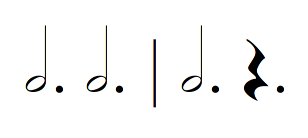
For the second solo section, things are usually speeded up a little. A common technique is to split up the plainchant melody mechanically into chunks with a fixed rhythmic pattern. In Reno, this pattern is the simple
The passage at “O Rudolphe” then becomes:
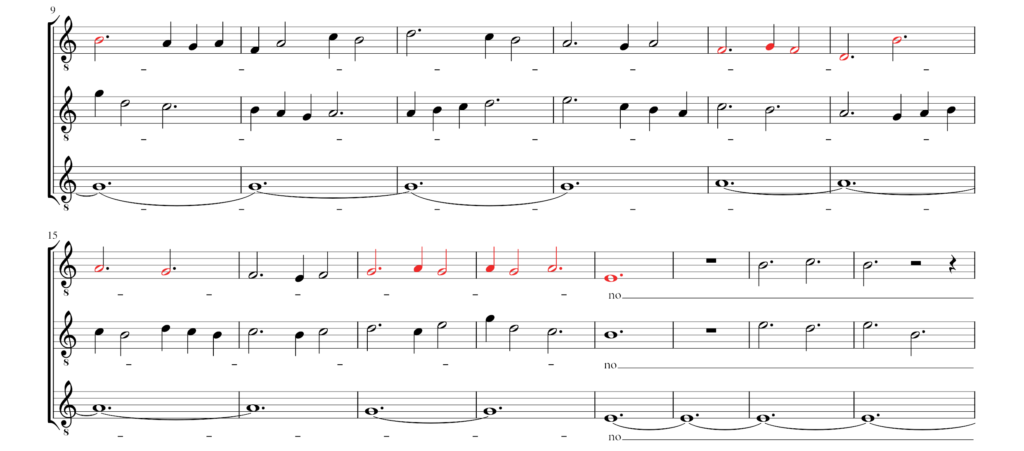
So there you have it: the bottom part is the “old” plainchant melody (i.e. the one from 2013), the upper parts are embellishments of this melody, according to the pattern established by Perotin, with some stylistic and even melodic borrowings.
It seems that the transition from plainchant style to Notre Dame style, certain melodic traits are emphasised, that may have been latent in the plainchant melody, but which in the new environment bear some resemblance with melodies of a much later date. Some of these similarities have been marked in red and green in the sheet music that accompanies the video.
Det finnes mange gode veiledninger til hvordan man bruker fotnoter riktig og utformer et spørreskjema, men ikke så mange som gjør koblingen mellom «hvordan» og «hvorfor» tydelig: hvordan gjør man i praksis, og hvorfor? Jeg formulerte derfor en tekst selv. Den er utformet med tanke på oppgaveskrivning i akademiske sammenhenger, men prinsippene kan med fordel ogsåbrukes på andre slags tekster.
Din tekst skal være en sammenhengende og helhetlig fremstilling av et emne. Bare det som hører med til fremstillingen, hører med i teksten.
Alt du skriver, skal være underbygd, enten med kildehenvisninger og referanser eller med argumentasjon.
Alt du skriver, skal ha en funksjon i fremstillingen som helhet.
Din oppgave er å overbevise meg – intet annet.
At du synes noe er interessant, gir jeg i utgangspunktet faen i; du skal fortelle meg hvorfor jeg skal synes det er interessant.
Du kan ikke overbevise meg uten å fange min interesse; skriv sånn at du utnytter det som er spennende i materialet.
Vær systematisk intuitiv: begynn med intuisjonen, magefølelsen: hva er det egentlig du synes er interessant, hva er drivkraften i ditt forskningsarbeid? – altså kløen, det som opprinnelig vakte din interesse. Destillér deretter, systematisk og gjennomtenkt, en problemstilling ut av dette, gjennom å tenke etter: hva er bestanddelene i min magefølelse? Hvilke spørsmål vil jeg ha svar på? Hvordan operasjonaliserer jeg dem – hvordan formulerer jeg spørsmålet sånn at jeg kan besvare det? Hvilket materiale egner seg best for å besvare spørsmålet?
Du skal starte i kløen – ikke fordi den nødvendigvis er veien til det mest interessante spørsmålet, men fordi det er fra det utgangspunktet du kan skrive den mest interessante teksten.
Kill your darlings.
Du skal være en huldretusse.
Skriv aldri «interessant» uten å fortsette: «… fordi …».
Angi kilder, også når det bare handler om noe som har gitt deg en vesentlig ide.
Ta eventuelle motargument mot den tese/argumentasjon du driver, i betraktning.
Skriv ikke alt du vet. Altså:
Du skal vite mer enn det som står i teksten.
Du skal bare skrive det som er relevant for spørsmålet, uansett hvor mye du ellers vet om nærliggende emner.
Bruk ikke «hermetegn» hvis det ikke er nødvendig eller hvis det ikke er fullstendig tydelig hvilken underforstått premiss hermetegnene bærer med seg inn i teksten.
Vær nøye med ord som «det», «dette», «den», «denne», samt «derfor», «altså», osv., altså ord som viser tilbake på et forutgående ord eller argument, og sørg for at det er helt tydelig hva det henviser til (og at koblingen er gyldig).
Gjør som Jan Guillou sier. Altså:
Gå straks i gang med å skrive! Heller dårlig enn ingenting.
Gå straks du har skrevet i gang med å tenke kritisk om din egen tekst.
Du er unik! Din kombinasjon av interesser og fagets nåværende tilstand har aldri tidligere forekommet, så hvis du mener at du har kommet på noe spesielt, så er det muligens tilfelle. Go for it. Det kan tenkes at du tar feil, men det er det bare én måte å finne ut på.
Du skal gjøre verden til et bedre sted med din tekst. Gjør du det, oppnår du evig lykke. Jeg lover.
One surprising aspect of Bob Dylan’s music making is his way of handling dominant connections. Or rather: his way of not handling them – by consistently avoiding them.
In the following I will suggest how he avoids the dominant, how he uses it when he does not avoid it, and why he treats it the way he does.
How to avoid
The most common cliché about Dylan – apart from the self-evident truth that he can’t sing – is probably that he only uses three chords, i.e. , the chords on the scale steps I, IV, and V, the classical Tonic, Subdominant, and Dominant (in the following abbreviated T, S, and D). This is not entirely correct, but not entirely untrue either: Dylan is not a sophisticated harmonicist – he mostly sticks to the main chord functions.
This is partly to do with his general predilection for genres based on blues and ballad, where the main functions have a central position.
This makes it even more remarkable that Dylan, out of this already meagre selection of chords, tends to avoid one of the three. And when he does use dominant chords it is almost always in the plain, triadic version, rarely using the opportunity to heighten harmonic tension that an added seventh would provide. Dominant seventh chords are rare in Dylan’s production.
I consider these two avoidances – of the dominant and of seventh chords – as two sides of the same coin, and when I talk about Dylan’s avoiding the dominant, it is more generally about avoiding the dominant function, whether in the broader sense of a major chord on the fifth scale step with a certain position in an habituated chord pattern, or more specifically: as the build-up to the tonic towards the end of a phrase.
Simple Twist of Fate
Simple Twist of Fate is a good example to start with. A number of different live versions can illustrate the role of the dominant.
On the live album Budokan (1978) the end of the verse sounds like this:
    C                     F
and wished that he'd gone straight
    C                 F      G        C
And watched out for a simple twist of fate.
In other words: a very classical tonal cadence of the most unremarkable form: T-S-D-T (C-F-G-C).
But in the original version from 1974, the ending goes like this:
    E           B/d#      A
and wished that he'd gone straight
    E                 B11             E
And watched out for a simple twist of fate.
What used to be the S-D part of the cadential figure (at “simple twist”) is reduced to an eleventh chord, a chord that is essentially a subdominant chord with only the bass tone left from the dominant.
This is a severe weakening of the dominant character of the chord: no leading notes left (i.e. the halfstep relation, which draws two chords together like a magnet), no T-S-D-T cadence progression, no sharp contrast between two different tonal areas, but instead a step in the progression which already contains the note of resolution, the tonic: instead of the leading note resolution D#–E, we have a penultimate chord that already contains E.
Between these two version lies the 1975 Rolling Thunder Revue tour, where the same passage sounds like this:
    G           D         C
and wished that he'd gone straight
    G                 Am              G
And watched out for a simple twist of fate.
The dominant is gone altogether! It is replaced not even by a subdominant, but by the subdominant relative minor. One can hardly get farther away from a tonal cadence (whereas it has certain modal traits).
In sum: The main part of the verse moves in the I-IV area and the melodic and emotional climax of the melody lies on the IV step, on “gone straight”. The dominant step on the other hand – to the extent that it is used at all, and regardless of how it is avoided – is merely an afterthought, a sidestep after the climax, after the tonic has been reached, far from the traditional dominant function.
Ballad of a Thin Man
To this trio of versions of a song can be added other songs where other strategies are employed. Ballad of a Thin Man (off Highway 61 Revisited, 1965) is our first example. On two points in the song there is an obvious opportunity to heighten the tension and drive towards the tonic through a stronger exploitation of the dominant function, but this opportunity is not taken advantage of.
The verses are mostly built over a chromatic descent in the bass:
Am
You walk into the room
/g#
With your pencil in your hand
/g
You see somebody naked
       /f#
And you say, "Who is that man?"
F
You try so hard
        Dm
But you don't understand
At the end of the descent comes the first marked return to the tonic:
C                  Em               Am
Just what you will say When you get home
It would not be inconceiveable with a major dominant chord here, but that never happens, not in a single live version through the years. On the contrary: in most live arrangements the entire phrase from “Just what …” is sung to a static riff on the tonic, without the slightest hint at the possibility of a dominant turn:
   Am                Dm/f Am
what you're gonna say
                  Am Dm/f Am (=intro figure)
When you get home
The other point worth mentioning in this song is the transition from the bridge to the verse. The bridge ends with a strongly emphasised and outstretched G major chord (dP), the relative major of the dominant, before the return to the Am of the following verse.
Dm                           G          ( --> Am )
tax-deductible charity organizations
This is the climax of the song, in terms of pitch and volume. Again, it would not be inconceivable with a chromatic bass ascent g-g#-a to tie the two parts together through the hint of a first inversion dominant chord (G – E/g# – Am). This variant actually does occur, during the 1984 tour:
   Dm                           G  .  .  .  E/g# ( --> Am)
To tax-deductible charity organizations
But in the absolute majority of the cases, this opportunity to create harmonic tension is left untouched.
Open Tunings and the Gospel Idiom
The previously mentioned album veresion of Simple Twist of Fate represents a specific strategy to avoid the dominant function, which appears from two different angles during the seventies.
The first stems from the album Blood on the Tracks, recorded in 1974, where the song first appeared.
In its first version, the entire album was recorded i open E tuning. In open E, the guitar is tuned to an E major chord, and while it is of course possible to play a straight dominant chord (most simply by playing a full one-finger barre chord at the seventh fret), it is not common, since one of the points of open tunings in the first place is to take advantage of the open strings as drone-like tones. Thus, if the top E string is left ringing with the B chord, it will in practice produce a B11, i.e. a subdominant with the bass note of the dominant, as we saw it in the music example above.
Thus, the eleventh chord, which fits his general reluctance towards the dominant function like a glove, was introduced in Dylan’s music thanks to the guitar technical experimenting with open tunings that he was engaged with at the time. But when it stayed in his idiom, it was thanks to the gospel tradition that Dylan dived into when he turned born-again christian in 1978. Here, it is one of the most characteristic chords, and after 1978 the eleventh is a fairly frequent variant for the dominant in Dylan’s songs – that is: a dominant that isn’t quite one.
Dominating the Blues
A large part of Dylan’s songs are based on the blues, in some form or another. In this area, the avoidance of the dominant is not so much a matter of avoiding a specific chord – most of Dylan’s blues based songs do after all contain the chord on the fifth scale step – but about Dylan’s way of relating to fixed chord progressions where specific chords have specific roles and functions.
So while it is certainly interesting that Dylan’s catalogue contains blues songs with no dominant chord whatsoever – e.g. Tombstone Blues – this is less significant than the myriad of variants of the “Twelve Bar Blues” that he uses throughout his career, and the general tendencies that can be gleaned from this material.
Here is the twelve bar blues as we know it and love (to hate) it from all the pub bands and stadium rock classics of the world:
I    IV   I    I7
IV   .    I    .
V    IV   I    V7 (turnaround)
Dylan quite consistently changes this pattern in various ways:
1. He lets the first part of the pattern, where the accompaniment lies on I, last for the entire first four-bar segment:
I    .    .    .
IV   .    I    .
V    IV   I    V7 (turnaround)
2. He also tends to avoid the otherwise so characteristic V-IV-I-turn towards the end, and instead replace it with a single V over the whole first part of the third line (The similar I-IV-I turn in the first line has already disappeared in the first reduction):
I    .    .    .
IV   .    I    .
V    .    I    V7 (turnaround)
3. He is not a big fan of turnarounds. They do exist, but not very frequently:
I    .    .    .
IV   .    I    .
V    .    I    .
This, then, is the blues pattern most frequently found in Dylan’s production, in this exact form or in one of the many variants in terms of phrase length, irregular rhythmic patterns, etc.
In addition to these concrete observations, some further tendencies can be noted:
A predilection for the treatment of the T-S connection, whereas D
seems to be used as a more dutiful step.
He seems to like long, static stages; for example, his preferred
version of the sixteen-bar blues is to stretch the initial T step to
twice its length, and his reductions 2 and 3 also work to prolong
even the other steps into entire stages, at the cost of the dynamic
drive that harmonic variation provides.
The range of variation between his different
versions within
the simple blues pattern is astonishing.
Standing in the Doorway
These tendencies or preferences are not limitied to his folk period in the sixties. The same characteristics can be noticed e.g. in Standing in the Doorway from 1997.
In a way it is a blues song: most of the verse is a statically repeated descending bass line, e-d#-c#-b, which functions as a stretched-out tonic.
It is followed by a passage around A, corresponding to the turn to the Subdominant in the blues pattern, after which we return to the tonic E again for yet another round of the static bass line.
In the place where the dominant would appear, corresponding to the beginning of the third line in the twelve-bar blues pattern, we then have the quick sequence A-E-B-F#-A-E, in other words: a chain of fifth-related chords, giving the impression of a dominantic circle progression since the chords become more and more “dominantic” in the sense that they get more and more sharps, but in this case the chain actually moves in the subdominant direction. Thus, it is not a constant discharge of an established level of tension, but a tentative “subdominantic persistency”, which ends on the secondary dominant, F#, which, however – possibly because of some minor variant somewhere in the mix, or because of associations (established thanks, in part, to the emphasis on the subdominant throughout the song) – is perceived more like the major variant of the minor relative of the subdominant, F#m.
In sum: after the long standstill on the tonic, we get a gesture that produces an illusion of a dominantic circle progression, but in the wrong direction and where the goal of the harmonic progression is not the Dominant in preparation of the return to the Tonic, but instead the Subdominant.
The Dominant, B, is a part of the progression, but its role is very modest: it is simple one element in the chain of chords that leads to F#:
A           E        B              F#
You left me standing in the doorway crying
A                           E
I got nothing to go back to now.
How Not to
avoid the Dominant?
As an illustrative contrast, it may also be worth looking at the cases where Dylan actually uses shamelessly dominantic turns and/or seventh chords. I shall suggest three areas:
1. Even though Dylan is disinclined to emphasise the dominant in his own blues songs, he gladly uses them as a genre marker. The most obvious example is Rainy Day Women #12&35 off Blonde on Blonde (1965), an almost-parody of an unrestrained New Orleans brass blues; but also the jazz pastiche If Dogs Run Free (1970) and various genre exercises from the country oriented albums from the late sixties fall in this category. What they have in common is the mimicking tone – as if he doesn’t really mean it completely earnestly.
2. Covers. When Dylan plays other artists’ songs, he is usually faithful to the original, also on this point. This is not least apparent in the series of Sinatra inspired albums starting with Christmas in the Heart (2009). Song upon song are overflowing with dominant circle progressions, performed with conviction and gusto, and no sign of shame.
3. But the most revealing group of cases are those that stem from guitar tuning and preconditions based on key. These are revealing precisely because they indicate that not only does Dylan happen not to play dominant seventh chords: he actually actively avoids them.
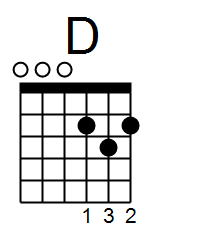
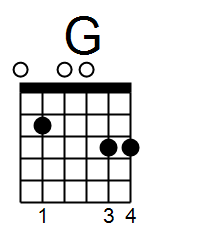
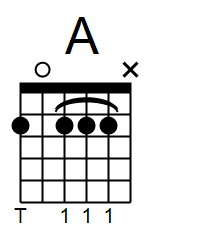
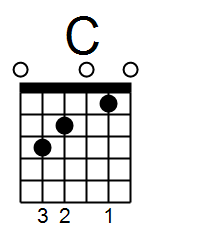
Two alternate tunings that Dylan used consistently during the sixties are called “Drop D” and “Drop C”. Here, the sixth string is tuned down one and two whole steps, respectively. In Drop D we have the three following main chords:
The main connection in this
tuning is between I and IV (D and G): they share open strings and
fixed fingers (the ring finger stays in the same place, and the index
finger moves a short distance) – they stand in a close relation
both on the fretboard and in sound. The dominant, on the other hand,
is slightly awkward, which can be heard, especially when Dylan plays
it: it calls for bigger hand movements and tends to sound muffled –
it is difficult to get the first string to sound properly. In this
tuning, the Dominant does not fulfill its potential to stand out as
the bright, contrasting contender.
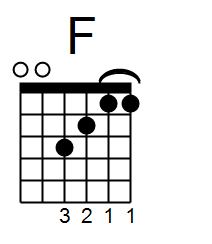
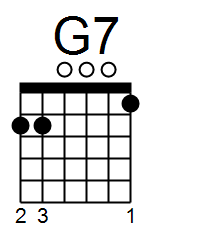
In Drop C, the way Dylan plays it, these are the basic chords:
Here, too, there is a close and natural relationship between I and IV (C and F), in terms of fingering, but in this tuning even the V chord, G7, is an unhampered part of the group. Both the S and D chords relate to the tonic chord according to the principle “least possible movement”, of which Dylan is a masterful proponent.
What is most interesting, however, is that the songs Dylan plays in Drop C are among the very few songs in his entire production where the dominant seventh is consistently used. Here is the version of It’s All Over Now Baby Blue from Live 1966:
E                       F      G7
Look out the saints are comin' through
    Dm            F         C
And it's all over now, Baby Blue.
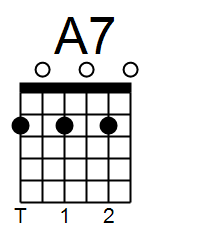
The alternatives to the two dominant chord shapes in these two tunings are worth a comparison:
In Drop D it would be possible to replace the muffled and awkward A with the A7 shown here if one wanted to. Soundwise it would definitely be preferrable – it would be easier to play and to use all strings to their full potential. But Dylan evidently risks a slightly bad sound rather than including the unwanted seventh.
But in Drop C, the risk involved in playing the straight G is apparently too big. It is possible to play it the way that is shown here, but it involves some acrobatics in the movements of ring- and little fingers, which one cannot allow oneself in a practical live situation where one stands alone with the guitar as sole responsible for the accompaniment. In such an extreme situation, Dylan permits the Dominant seventh, but that is how far out we have to go. That’s how much he seems to distrust this chord.
The difference between the chord shapes in Drop D and Drop C, then, is a strong indication that Dylan prefers the straight dominant to the heightened harmonic tension of the seventh.
One last example in this area might be mentioned: Dylan remarkably rarely plays in E major, even though that is one of the most common keys to play in in the genres that Dylan enjoys. There may be many reasons for this, but it could be a contributing factor that it is more difficult in E major than in many other keys to find suitable chord shapes to avoid the dominant seventh.
Why?
So why this resistance to
dominant chords?
Early Country Blues and English Ballads
One explanation that lies close at hand is that in the music that is Dylan’s bible, the dominant function is not important. This goes for the early blues as well as for the English ballad tradition.
In the early blues that Dylan soaked himself in early in his career, the dominants are generally few and far between, and it is not a coincidence that Dylan bases several of his songs in part or in full on the Pretty Polly pattern, where a pentatonic phrase is played around the first scale step, then repeated around the fifth, and rounded off with a return to the tonic again – often played without differentiation in the harmonic accompaniment:
Pretty Polly, in Doc Boggs’ inimitable banjo version.
The fifth scale step represents an alternate tone area, but does not have the function of harmonic tension that it has in a harmonic progression.
The simple version of the blues pattern that Dylan prefers, without V-IV turns and turnarounds, comes the closest to the Pretty Polly pattern: the chords are static layers, around which melodies and instrumental figures can move relatively freely.
The Anti-Harmonical Dylan
What the examples above seem to indicate in a more general sense, is that in Dylan’s music it is not harmony that rules the musical progression – it is the voice (partly, but not just, as carrier of the text) and the phrasing. The long stages on static levels are far more open to variations – spontaneous as well as planned, as in language – than the pre-defined steps of the established harmonic patterns of tonal harmony.
And this seems to be a very conscious choice.
I have elsewhere argued that what Dylan does – although he “can’t sing” and “only knows three chords” – is to make prose music: he treats the obviously stylized and strongly regulated world of sound that musical expression necessarily is, as if it were equivalent to the sound world that language is when it does not appear in poetic form – that is: in the form with a level of stylization that is equivalent to what music usually is.
He explores the common grounds between language and music, in other words. That is the art form that in which he excels: the exploration of the conection between the sonourous qualities of language and the quasi-conceptual qualities of music. He pretends that it is possible to talk in prose through and within music’s poetic world of rhythm patterns and established harmonic progressions.
And in this framework, there is no obvious place for the dominant, since it, by being a purely musical mode of expression cannot be “proseified” so to speak: pure harmony is the one element of music that lacks a direct equivalent i language (the idea of several voices at the same time, which is the foundation of harmony, in the area of language more than anything evokes images of quarreling or power games). And the dominant is a pure representative of this: there is no linguistic correspondence to or element in the seventh chord.
But if the dominant is instead reduced to a static stage without necessary consequences (such as: the tonic), it can still be drawn into the Dylanic art form.
A corollary of this argument is that Dylan is not a literary artist (and hence it was a mistake to give him the Nobel prize), nor is he solely a musician (and hence it was a mistake to put him through the ordeal that was the Polar prize) – he is a prose singer, and in prose, the dominant has no obvious place.
First presented as a paper at the annual conference of the Swedish Musicological Society in 2018
DISCLAIMER:To some extent, this text is still a draft, in that there may or may not be too much or too little music theory in it. I intend to revise it, so if you have comments that may be useful in that respect, I would be very grateful. Use the comment section or send me a mail
From a musical perspective, there is one song on Dylan’s recent album, Rough And Rowdy Ways, that stands out: Black Rider. One may not initially notice it: on the surface the song fits nicely in with the rest of the album: rather slow, melodically nothing much more than a monotonous recitative, a nicely sounding canvas for a fairly wordy set of lyrics. But harmonically speaking, it is in fact probably Dylan’s most complex song ever (that is: if he has written it himself, which obviously can’t be taken for granted these days, given his track record of musical thievery. But for the sake of argument: his most complex song).
Among the candidates for “most complex song” – In The Garden is the most obvious one, but Ring Them Bells and Dear Landlord also come to mind – it is also the most interesting one in this respect, since the very nuanced harmonic progressions are not immediately perceptible as complexity – they feel very natural, and yet they contribute very strongly to the expression of the song. A comparison with In The Garden underlines this: there, the complex harmonies sound slightly contrived – interesting, but in a way that draws attention to itself and not to the song. Here, one hardly notices them. And yet, they are an important aspect of why the song seems to suck the listener in. I’ll try to show how.
The material description
If
one follows the traditional division of the musical material into
melody, harmony, and rhythm, Black Rider
is all about the harmony.
Rhythmically, the whole song consists of a sequence of chords with no fixed rhythm, just calmly strummed, two chords for each line of text, from beginning to end, with no change, no development. Just the chords.
Dm       A/d       Dm      A/d

      Dm                 A7
Black rider, black rider, you've been living too hard
     D7                    Gm
Been up all night, have to stay on your guard.
    E7/d                          A7/c#
The path that you're walking, too narrow to walk,
D7/c                    Gm/bb
 Every step of the way, another stumbling block.
Dm/a                           A7
 The road that you're on, same road that you know,
Dm6/a
Just not the same as it was
A'         Dm       A7/d       Dm      A7/d
 a minute ago.
The
melody to which the
lyrics are sung is not really a melody. It is more like a recitative,
basically with one tone per
chord, repeated with
a consistency that is surprising given Dylan’s incapability of
sticking to one note (at least when he’s supposed to – unlike the
unbearable one-note samba impersonations he used to do back
in the day,
whichever song he was singing). So no melody to speak of, just the
words.
Which
leaves us with the harmony.
In
the following I will go through the song, chord by chord, verse by
verse. There will be some music theory; I’ll try to make that as
brief as possible.
Verse 1: Same road, just not the same that it was a minute ago
The
song begins with the four chords
Dm – A7 – D7 – Gm
(In the following I use bold for chord names, Uppercase Italics for note names, and Bold Italics for the abbreviated functional harmony names that will show up here and there.)
Bar .1-4, with the chords Dm – A7 – D7 – Gm
In these chords lies the seed of all the developments that lie ahead. Here is why:
The three chords in a “three-chord song” are the keynote (also called the tonic), together with the chords on the fourth and fifth steps above the tonic (the subdominant, and the dominant, respectively). In a song in D major, these chords would be D, G, and A.
Minor keys differ from major keys in some important aspects. One is that the dominant is almost always a major chord, even though a minor chord might have been expected. The reason for this is that we absolutely want that halftone-step leading from the third of the dominant chord (c# in this case) back up to the keynote of the tonic. That halftone is the glue that keeps all western harmony together.
Going from Dm to A7, then, is expected, since these are the main chord functions of any key: the tonic and the dominant. Returning to a D chord is also expected; after all, the A7 is there to build up tension so that the return to the tonic feels even more satisfactory.
But
here, we don’t return to a regular tonic. Instead, we get a D7.
What difference does that make?
Quite a lot, actually. The added seventh transforms the chord from a tonic – the bringer of rest and stability – into a dominant – the bringer of tension and trouble. That tension needs to be resolved, and in principle, the resolution of a dominant always happens the same way. A7 resolves to Dm because of the halftone step from c# to d and the step from g to f in the lower voice. And, correspondingly, D7 resolves to Gm, which is exactly what happens here.
Resolution from Dominant to Tonic.
And Gm is not a stranger in a song in Dm. In fact, as indicated above, it is the subdominant, the last of the main functions in any key, together with the tonic and the dominant.
The core of traditional functional harmony is the progression T-S-D-T, and the notion that these chords represent different functions in a musical narrative. We begin and end with a Tonic, the stable foundation; the Dominant is where the action takes place; and the Subdominant is a preparation to get away from the calm quiet of the Tonic.
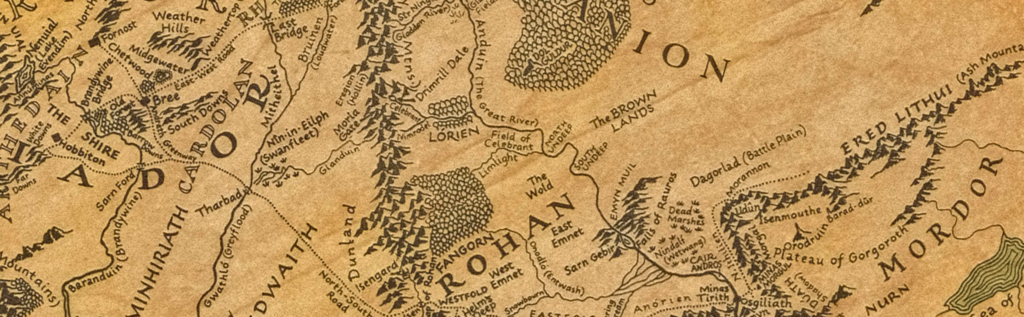
It could be likened to the Lord of the Rings: the Tonic is Hobbiton and the Shire, the Subdominant is Frodo’s first hesitant steps on the road that leads from his cozy hut with the round door, out into the wide world; and the Dominant is Nazguls and orcs and Mordor and all that; and in the end, we’re safely back in Hobbiton again. In other words: T-S-D-T. You have heard that progression thousands of times. It is e.g. the first line of Blowin’ in the Wind.
This means two things for the story of the Black Rider: after Dm–A7–D7–Gm, we have been through all the narrative steps in the story, so we might in principle be ready for a return to T again. The problem is that we have gone the wrong way. Which means: we are not done yet – we have only just begun: what we thought was Mordor back there in the second bar, turned out not to bring us back to Hobbiton after all; in hindsight we can see that it was really part of the preparation to get to Bree, the little village just outside of the Shire, or in more technical terms: the subdominant (Gm) in the fourth bar.
Thus: (a) only now are we ready for the real Dominant step, and (b) we may not have traveled very far, but we’re already a long way from home. (Or as Sam expresses it: “If I take one more step, I’ll be the farthest from home I’ve ever been.”)
Exactly how long, is determined by several things. It would have been perfectly possible to continue: Dm-A7-D7-Gm-A7-Dm:
In other words: tack on the two remaining functions, in the correct order, and be done with it. As we have said: A7-D7 is just an inserted preparation for Gm, so the longer progression is just a slightly embellished version of the plain Dm-Gm-A7-Dm.
There are two problems with this. One is that after such an elaborate preparation just to get to Gm, it would seem a little anti-climactic with just a sudden return to the tonic. We are led to expect more than that.
The
other is that most music in most musical traditions organize phrases
in groups of four. If we perceive our first four chords as one unit,
we would expect things to happen in similar groups. The suggested,
longer sequence only adds half a unit. With
the added preparation to Gm, the short option Dm-Gm-A7-Dm
is no longer an option; and adding -A7-Dm
at the end disrupts the four-unit phrasing. Apparently,
we’re in for a longer haul.
To
understand what is happening here, let’s have a look at the bass
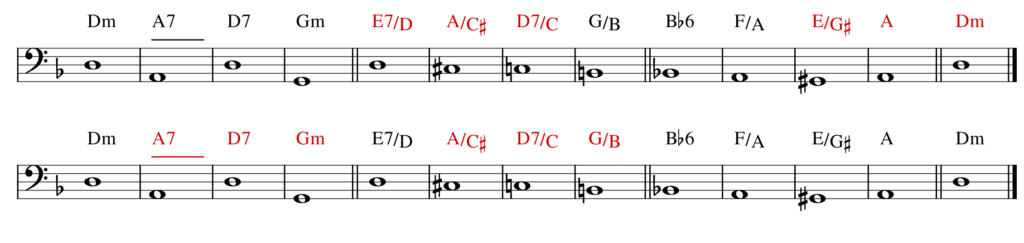
line of the whole verse:
Verse 1, bass line and chords
In the first four bars we oscillate between the tonic and the the keynotes of the D and S, respectively. Bar 5 brings us back to the keynote d again. Then follows a mostly chromatic descent from D down to A, which looks like a slowed down and stretched out echo of the first two bars, as if to say: “Whoa! You were going way too fast there, buddy – we weren’t ready for Mordor just yet, but now we are! Bring on the orcs!”
Once a has been reached – the first chord of the third four-bar unit – the bass stays there throughout the whole unit, until the return to d and the end. This Dm chord is extended into a four-bar interlude, which brings the total chord count up to sixteen, divided into four regular units of four.
The harmonic “narrative” of the first verse could be represented like this:
Verse 1: four-bar units and phrases. The symbols below the music indicates the high-level functional analysis: after the initial t–s (lower-case letters denote minor keys, upper-case letters major keys), the whole second unit leads up to D, which is in effect all through the third unit.
We
have a
slightly elaborate way of getting from t
to s; then
a long build-up to an
extended D;
followed
by a
well-deserved rest on t.
But what about the chords? The bass line may return to d in bar 5, but that’s not a Dm chord, and the A7 that I claimed was dominating the whole passage from bar 5 to 12, is hardly there until the very end. What’s going on here?
First of all, if we leave out the bass tones, we may notice that the progression A–D–Gm from b. 2–4 is repeated in the second unit. This time it is preceded by E7 instead of Dm; this expected Dm instead follows after the progression.
To make a long story short: In the first unit, Gm was prepared by its dominant, D7, in turn prepared by its dominant, A7. In the second unit, the chain starts one step earlier, in that A7 is in turn prepared by its dominant, E7. In technical terms, a dominant that prepares for something other than the keynote, is called a secondary dominant. What we have here, then, is a chain of secondary dominants, and this whole passage, E7–A7–D7–Gm, is a way of saying, in music: “wait for it… wait for it … wait for it … Now!”
And finally we are ready for a real Dominant. One little detail emphasises its arrival even further: This second time, the Subdominant is not played as a regular Gm chord, but with Bb in the bass. As mentioned, its function is to lead up to the dominant, and the halftone-step in the bass strengthens this effect. Halftones do that, as we have seen: they are like magnets, pulling the chords on either side towards each other.
So everything in the second four-bar unit works together to fulfill the promise of the dominant that has been delayed for so long, and when it arrives it is only natural that it enters as strongly as possible: on the first beat of the third unit.
And yet: after all this fanfare and preparation, it may seem a little disappointing that what follows after Gm is not a straight A, but a D minor chord with an A in the bass – Dm/A. In music theory, this is called a “double suspension” – a sus4 chord on stereoids, where not one but two of the chord tones have been temporarily displaced.
In a regular Asus4 the third, C#, is replaced by the fourth, D, which dissonates with E for a while until the tension is resolved when D drops a half-step back to C#. In a double suspension, even the third tone E is suspended to F and released back to E again, all in the service of heightened tension. So while it would be notated as a Dm chord, it functions as an A chord – a prolonged dominant.
One last observation can be made before we continue the song. It is as if the bass line and the chords tell slightly different stories, or present different perspectives on the same story, so that we are made to expect one thing but get something slightly different. The bass line of the first unit leads us to expect a D of some kind, and we do get that, but “only” in the form of a twisted tone in an E7 chord. Then, after the second unit, we strongly expect an A of some kind; and again, that is what we get, but this time in the shape of a Dm – the chord we expected earlier.
This
is in fact a recurring
theme throughout
the chord progression of
the song: things aren’t always what they seem; we’ll get there,
but in time, and not always in the time you were
expecting.
Same
road, but different.
Verse 2: You fell into the fire
and
you’re eating the flame
Which brings us to the second verse. It can be dealt with much more quickly, since the basics are now in place:
      Dm                 A7
Black rider, black rider, you've seen it all
       D7                  Gm
You've seen the great world and you've seen the small
    E7/d                          A7/c#
You fell into the fire and you're eating the flame
D7/c                    G/b
Better seal up your lips if you wanna stay in the game
Bb6                    F/a
Be reasonable, mister, be honestly fair
     E/g#
 Let all of your earthly thoughts
A    Dm       A7/d       Dm      A7/d
be a prayer
It begins just like the first verse, and one might listen through the whole thing without really noticing that something has changed – at least that’s what I did, until I sat down to write down the chords. When I got to “… if you wanna stay in the game” in the second unit, I had to go back to the first verse to check if I had misheard something or just made a typo, for clearly, that’s a B in the bass, right, and not a B flat?
Right. G/b here. And Gm/Bb in the first:
This is the first in a series of changes with long-reaching consequences. As we saw in the first verse, the bass Bb at the end of the second unit was a strong indication that next up would be the strong effect of a dominant, deserving to enter on a strong beat, i.e. the first bar of the unit.
But this time, we get a B instead in that spot. And this is not just any spot: we are in the middle of a pronounced chromatic descent, going slowly but steadily from D to A. So what to do?
Dylan
does the only reasonable thing: insert the Bb anyway and prolong the
descent, so that it now fills every halftone in the interval between
d
and a.
Here’s what it looks like:
Verse 2 with four-bar units and phrases (audio from b. 5).
What this tells us is that since the descent has been prolonged, it disrupts the regular structure of four-bar units: the awaited A no longer enters on the first beat of the third unit where it belongs, and the descent actually continues past A.
Dylan’s solution is simple and consistent: the structure that was established in the first verse calls for a full unit of a. This has been prevented by the inserted B, but there are more ways than one to accomplish the goal. One can for example circle around the tone, so that its presence is felt even when it is not actually sounding, something like this:
How to fake a continuous presence of a tone.
This is of course an interpretation, but if we accept the bass tones Bb-A-G#-A of the third unit as a continuous presence of A throughout the unit, we may say that the chromatic descent in the second unit and the sustained A in the third overlap, as indicated with the slurs in the graph above.
The changed bass line calls for changes to the chords as well. G# is easy: it is the third of E major, which – do we notice a pattern here? – is the dominant of A. Thus, the last three chords (E-A-D) echo the beginning of the second phrase, just as the last three chords of the second phrase (A-D-G) echo the end of the first:
Verse 3: I’m walking away,
you
try to make me look back
The third verse is remarkable:
      Dm                 A7
Black rider, black rider, all dressed in black
    Gm           Dm
I'm walking away, you try to make me look back
Bb                               F/a
My heart is at rest, I'd like to keep it that way
E7/g#               A7/g
I don't wanna fight, at least not today
D/f#                  Em7-5
Go home to your wife, stop visiting mine
Bm7-5/a                   A7
 One of these days I'll forget to be
Dm       A7/d       Dm      A7/d
kind
Verse 3, phrase structure with full harmonic analysis. “(D)” denotes a secondary dominant, i.e. a dominant to anything otherthan the tonic.
In a way, Dylan tries to cheat, but harmony strikes back.
The first unit does exactly what I hinted at in the discussion of the first verse: we have a t, a D, and an s, we’ve been through the main functions, so why not just go straight back to t again, and we’re done?
Because the Dominant needs to be the last thing that happens before the end. Here, we go Mordor–Bree–Hobbiton – A7-Gm-Dm – which is a strange narrative.
And sure enough: We have reached the tonic too soon, and payback is a bitch.
Dylan’s solution is quite advanced. If we look at the verse as a whole, we recognize all the elements we have discussed so far: the D-A-G-D oscillation in the beginning, the chromatic descent in the middle, and the prolonged A–D in the end. But things have changed: the oscillation is shortened, the descent no longer goes from D to A, but from Bb to E, and the quick and simple A–D ending is now a two-step action E–A–D. What has happened?
First, we notice that the bass line Bb-A-G#, which used to belong to the third unit, as part of the circling motion around A, now instead is what sets the chromatic descent in the second unit in motion. The chords are the same, the bass line is the same, but the function is different.
We may also notice that just as the Bb in the second verse was “actually” sort of an A, insofar as it belonged to the circling around that note, we might consider it as an auxiliary to A even this time: we have established that the function of the second unit is to descend slowly from D to A; in the third verse, it seems, we descend from a to e instead, but the interval through which we are descending is the same in both cases: a fourth.
Everything seems to be logical – except: how did we get to Bb this time, and by the way: what is the E at the end of the descent doing there anyway? This seems to go against the narrative that we have established so far: we thought we had reached the height of action and tension in unit one, we then realised that we had only just begun, therefore the dominant, A, had to be carefully prepared, to make sure that the resolution of the tension was consistent and clear.
Now, however, if we take the descent to be doing the same thing as in the second verse, the role of the dominant seems to have been taken over by E instead of the real dominant A. But this would mean that we have built up tension – and our justified expectation of a resolution – around the wrong chord: if E is the dominant we’re preparing for, that means that we are anticipating a calm and peaceful return to … wait: to Mordor! to A, the dominant!
That
seems wrong.
And
it is. Not because the tones are wrong, but because we’ve been
fooled. Here’s what is happening:
The Bb doesn’t appear out of thin air. Tonal theory operates with two central concepts: the three main functions that should be familiar by now (T, S, and D), and the notion that a major chord has a relative minor – a cousin with the same genes, but slightly more sombre (and vice versa). The easiest way to determine the relative chord is to look at the number of flats or sharps in the key signature: the relatives are the chords with the same configuration – of black and white keys on the keyboard, if you like. A minor and C major use no black keys, so they are relatives.
Relatives share properties, and one can sometimes stand in for the other. I discovered this for myself when as a kid I was learning to play the guitar and had serious problems with the F barre chord, which seemed to be used everywhere. I could not play it, because my index finger was only nine years old and unable to press down all those strings. I fooled around with the other chords I had learned, and I figured out that, miraculously, I could often use Dm or Am instead.
Only, it wasn’t a miracle: Dm is the relative minor of F – that is why.
G minor uses two b’s in the key signature, and so does B flat major, so they are relatives, functionally. Thus, when Dm enters prematurely after Gm and then continues to Bb, this is a way for the tonic to say: “Fine, I came in too early – I’ll let your cousin take over.” Bb corrects the “mistake” made by Dm, and since an important function of the relative is to indicate that we are not quite ready yet, it is doubly appropriate there, at the beginning of the second unit.
And since Bb has also already been established as a legitimate way of getting to A with emphasis, once we’re there, the progression that follows is unproblematic.
But what about the E at the end of that progression?
Let’s have a closer look at that chord. In the tab at Dylanchords I have written it as Em7-5, since that is the name and shape that is probably most familiar to most people, and since it also corresponds well with the bass note.
But as is the case with many of these complex chords, it can be spelled in many different ways. It consists of the tones E, G, Bb, and D (Bb being the lowered fifth, the -5, from E, and D being the seventh). Bb is not naturally a part of the Em chord – it has been violently, surgically altered from the B that would have been the natural inhabitant of the chord. Altered chords are strong medicine; you do that to them for a reason.
But look at the tones again: G is the keynote of the subdominant; Bb is the parallel of Gm as well as the third in that chord; and D is the tonic, as well as a natural member of the G minor chord – the very same chord that was carrying the protagonist’s hat for a moment back there. Let’s call it “Sam Gam-Gee Minor” (and recall the brief period when Sam was the Ring-Bearer). In other words: Em7-5 can also be spelled Gm6/e.
Em7-5 = Gm6/e
And then everything falls into place: the chromatic descent, which so far has worked as a preparation for the dominant, turns out instead to be a prolongation of the subdominant that was so rudely cut off a couple of bars earlier. The E that so far in the song has appeared only as a pseudo-Mordor (or as the theorists call it: a “secondary dominant”) to the dominant A, turns out to be nothing more than a colouring nuance of the subdominant Gm.
This
in
fact also means that the circling motion that was introduced in the
second verse, as a way of accommodating
the slightly longer chromatic descent
and
merging it with the sustained dominant,
is
now
shifted
forwards a couple of bars and down a couple of steps, just in time
for the now extended subdominant to give way – subordinately, of
course – to the dominant.
This gives the following simplified chart of the third verse:
Verse 3, simplified harmonic analysis.
The
first unit really ends
with the
subdominant, Gm, which is in effect all the way through the chromatic
descent until the Em7-5 chord, including the circling motion, where
it gives way to the dominant for the last two bars before the end of
the verse.
Verse 5: you’ve been on the job
too
long
The fourth verse is mostly a repetition of the second verse, and the fifth verse a repetition of the third. Or is it?
Not
quite. It begins the same way,
with the Gm cut off prematurely by Dm, but there is one trick left up
someone’s
sleeve. First, have
a look
at the third unit:
Verse 5, phrase structure.
We are back where we started in verse one! The whole third unit is taken up by an extended A, which resolves, as always, to the final Dm.
Then have a look at the second unit: The circling is back where it started in verse two, as a prolonged A, but this time shifted one whole unit to the left. That is the price one pays for disrupting the natural flow of events, jumping in with a happy ending before it is due: Mordor – the dominant A – takes over the entire verse.
Or does it? Towards the end of the verse there really isn’t much of Sauron’s destructive force left. There is a limit to how long you can sustain dramatic tension, and now there is hardly any energy left. This is perhaps most clearly heard in the chord that now begins the third unit, at “some enchanted evening” (incidentally a reference to wizardry and magic – quite fitting, given the Lord of the Rings metaphor – but also to the song by that name, which Dylan released on Shadows in the Night, the melody of which begins, aptly enough, with a circling around the first note). It is not really a chord, in the sense that it doesn’t have a tonal function at all, it is just an A where the whole thing is shifted down a semitone while the bass tiredly hangs on to its A.
Other lines
So there it is, a complexity that is unheard of in Dylan’s oeuvre, consisting of a consistent manipulation of a few blocks and gestures, and exploiting the niceties of functional harmony.
The lines that I have singled out in the analysis are not the only ones at work in the song. Below is a four-part setting of the first verse – not to suggest to anyone that a choral arragement of Black Rider would be a good idea, God forbid, but to highlight these implicit lines in the other “parts”. Most prominent is the chromatic ascent in the beginning of the “soprano” part, but also the start of the “alto” part is clearly audible as a characteristic chromatic line. In addition I could also have pointed out the run of parallel sixths between soprano and tenor in the third unit.
Four-part version of the first verse, with the main outline of Dylan’s recitative as a solo part at the top.
Lyrics and Music
One final question: Does Dylan know all of this? Probably not.
Are the musical complexities reflected in the lyrics, and vice versa? Possibly. At least the first verse ends: “The road that you’re on, same road that you know, / Just not the same as it was a minute ago,” which could be interpreted as a parallel idea to the ever-changing harmonies which seem the same but aren’t (that it could doesn’t mean that it should, though). The second verse, which is where the harmonic complexities are most dominant-oriented, also has the most dramatic lines, such as the one quoted in the heading: “You fell into the fire / and you’re eating the flame” (and again: the topical similarity with the Lord of the Rings is completely unintentional). And the last verse ends “Black rider, black rider, you’ve been on the job too long,” a quotation from Duncan and Brady, a song that Dylan used to sing, about a guy whose dominant powers are waning.
There is no doubt that such connections can be made, but this is no surprise: the greater the complexity, the greater the opportunities to find parallels and correspondencies, even unintended ones. Dylan has always been lauded for the complexity of his lyrics, open to a wide range of interpretation. Harmonically – not so much. There is only so much one can do with three chords in fixed patterns. I have made some attempts at harmonical analysis of Dylan songs over the years – Dear Landlord, Just Like a Woman, and Mr Tambourine Man come to mind – but I readily admit that they have been made to a large extent out of spite, in opposition to the tendency in popular music studies to study everything but the music itself.
It is therefore unavoidable that part of the conclusion must contain an opening towards suspicion. The sudden appearance of a song like Black Rider, where harmony takes centre stage for the first time in his 60 years as a song-and-dance man, at time when Dylan has spent a decade deep-diving into the repertories of the highly skilled harmonicists of the Sinatra era, must make one wonder if there isn’t a sheet of music somewhere out there among the millions of songs from the first half of the twentieth century with a complex chord sequence in D minor which changes from verse to verse. The fact that there is one verse which is simply repeated, without any change, actually points in that direction.
We may never know. If someone does indeed dig out the original, I will not be surprised. Until then, I am going to enjoy Black Rider, more and more each time I play it.
Here we go again: Dylan has nicked a song from an old, forgotten musician, and the apologists flock around him in his defence. This time it’s False Prophet from his recent album Rough and Rowdy Ways that has been found to be remarkably similar to If Lovin’ Is Believin’, an obscure B-side from a Sun Records single from 1954, recorded by Billy “The Kid” Emerson, who is perhaps vaguely remembered by a handful of early R&B nerds for some other single from the same year, but otherwise completely forgotten (although still alive, and now known as Reverend William Emerson).
Here’s what the defending army say (this and this article sum up the arguments quite nicely, the following is a condensed list):
– It’s the folk tradition!
– Thank god there were no copyright laws when Shakespeare was around!
– Dylan’s changes to False Prophet may be small but they are significant, so it’s not really plagiarism.
– Dylan is doing the original creators a favour. If he hadn’t stolen their songs, nobody would have listened to them anyway.
– He may have borrowed a tune here and there, but it’s not done with any ill intent, so at least it isn’t plagiarism.
– There are only so many notes out there; similarities are bound to appear.
– Besides, who knows, maybe Dylan has settled this privately with the originator; then everything is handy dandy, right? Right!
– He may have nicked the arrangement, but arrangements can’t be copyrighted.
These allegations, that are more or less related to the contents of the songs and the intentions behind, are frequently accompanied with an “inverse moral indignation” on the part of those who feel hurt by criticism of Dylan:
– The mean detractors are always looking for ways to put Dylan down.
Dylan himself has come out strongly with this argument, stating, when asked about the accusations of plagiarism:
Oh, yeah, in folk and jazz, quotation is a rich and enriching tradition. That certainly is true. It’s true for everybody, but me. There are different rules for me.
To which there is really only one thing to say: Boo hoo, Bob! Yeah, you’re being so unfairly treated. No go cry on someone else’s nanny’s shoulder.
But for the rest: Do these arguments redeem him, and if so, and perhaps more importantly: of what? What are the charges? What are the issues, what is at stake here?
In this text, I would like to (a) briefly summarize the issues; (b) go through some of the evidence that is frequently cited, on either side, whenever Dylan’s alleged plagiarism is discussed; and (c) suggest two test questions that may help to decided whether and why (or why not) it matters that Dylan steals.
I should mention that without this text I probably wouldn’t have written the following; I hope I haven’t stolen too much from it. I don’t think so.)
The Charges
The accusations mainly fall into two categories: one having to do with copyright and the legal issues surrounding it; the other more vaguely connected with questions of what is wrong and right, justifiable or damning. In both cases one could argue that matters are very clear, but also that they aren’t, and that whatever clarity a decision on those particular issues may bring, may not even matter. What’s important with False Prophet can probably not be reduced to a legal or moral matter. This is after all human communication, art, stylized emotions we’re talking about here – emotions stylized in sound, at that: in the medium where language takes place, but without the added burden of conceptual thought.
Put simply: what Dylan is doing on False Prophet may be important, but whether or not there is a paragraph in a law book somewhere that may send him to jail (or a commandment to send him to Hell) is of no importance for this question.
Copyright Law
In a way, copyright law is real simple: if you’ve produced something, it’s yours to sell, even if it is not a material thing. If you carve a flute out of a marble block, it’s yours; you can play on it as much as you want. What copyright adds is that if you come up with a great melody while playing, that tune is also yours, and nobody can copy it and claim it as theirs. You have the “copy-right”.
So far, it’s simple, but that’s also where “simple” ends. There are two major obstacles: if it’s not a physical thing but some intangible activity that is being copied, how is one to determine what that object is and where the limits are of what constitutes copying? And: what does it really amount to, this right of yours? Who is going to protect it, and under what circumstances? And against what?
Is it the principle of a hole through a piece of marble, the finger holes, the shape of the tailpiece, the particular sound it makes, the size, the colour that determines your flute? How identical must my flute be to yours before you can start complaining?
The comparison with the marble flute even highlights one of the serious problems with copyright protection: it really only applies to ideas or realizations of ideas, not to actual things. If I see your marble flute and copy it, it is not my flute that would be an infringement; only if I sell it, for example under circumstances where you had made a name for yourself as the Carver of Flutes and I somehow made money not primarily from carving my own flutes, but from your idea. The equivalent to a copyright infringement would be if I simply stole your flute and sold it. Copyright law is about protecting ideas as if they were physical objects; and about protecting your right to make money from your formulation of an idea (but not your right to the idea itself).
Fundamentally, the idea of copyright presupposes a society where doing something that does not put food on the table or produces something tangible, such as a marble flute, is still valued, which is a quite advanced idea. But since it is more difficult to define an idea than a flute, copyright law is a mess. And since it’s mostly about the right to make a money from non-tangible activities, it also comes in touch with other areas of money-making, including corruption, exploitation, abuse, etc. Money doesn’t talk, it swears, you know.
It is worth noticing, for example, how the goal of copyright is defined in US law:
To promote the Progress of Science and useful Arts, by securing for limited Times to Authors and Inventors the exclusive Right to their respective Writings and Discoveries.
Yes, it is We, The People who shall benefit from the protection (for Limited Times, mind you) of your right to your Writing, since it may turn out to be a “useful Art”.
That’s fair and good; it is your choice not to till the earth but write poetry instead, and if you can make people pay for your bread, then all the power to you. But why is it then, for example, that copyright protection does not end when you die but usually lasts until you’ve been dead for 70 years? If you’re not there to eat the bread your poem has earned you, then what right is there to protect? Could it be that a law that was made to ensure you the right to earn your living from something useless, because we as a society feel that we benefit from that, is instead being used by parties with economic interests of their own, such as publishers, licencees, lawyers, etc., to secure a long-term, effortless income?
Yes. Copyright law aims to fulfill an aim that is good both for society and the individual – the right to improve society without necessarily putting a bucket of grain or a marble flute on the table to prove your worth – but since the object that is protected is both intangible and vague, and since the area in which it is protected is a commercial one, it is inevitable that there is a gray zone that can be exploited.
The other cluster of objections has to do with morals: it is wrong of Dylan to do what he has done, whether or not it is legal.
I happen to fall into this category myself: I think it’s a disgrace for one of the greatest creative minds of the past century to sink so low – and to consciously and consistently do so – that he can’t even bring himself to recognizing his debt to those who have gone before him. At the time he released Modern Times, it might have been written off as a faulx pas, but not anymore: it’s a consistent modus operandi, and that’s not OK.
But here’s my problem: I can’t really anchor my position securely anywhere. The law is problematic since it mainly protects things that I’m skeptical of in the first place (such as the right of crooked corporations to claim ownership of expressions of ideas that should belong to mankind), and morals are at least disputable and in any case hard to define.
I therefore need firmer ground. Hence the following discussion of some items that have been brought up in the discussion – this one, and those that have taken place before – whenever Dylan’s thievery comes up.
Exhibit A: Blowin’ in the Wind is based
on No More Auction Block
One of the cases that curiously enough is always brought up in these situations, is the roots of Blowin’ in the Wind in the old spiritual No More Auction Block (again closely related to We Shall Overcome).
It
is curious for several reasons: the influence has never been denied,
it has always been described as a point of departure, an inspiration,
but hardly more than that, and the similarities really aren’t that
substantial.
This ought to have made it an irrelevant argument, on either side, but since it is constantly referred to, let’s get the facts straight:
The similarities between the two songs are obvious but limited. The beginning is identical, when it comes to the melody, the harmonization (the album version differs slightly, but most live versions use the same harmonization as on No More Auction Block), and the phrasing:
And the end is equally similar:
Nobody would dispute this, and nobody has. Pete Seeger pointed out the similarity and the origin, as reported in John Bauldies liner notes to Bootleg Series 1–3 where Dylan’s recording of No More Auction Block was released, and Dylan himself said so:
Blowin’ in the Wind’ has always been a spiritual. I took it off a song called ‘No More Auction Block’ – that’s a spiritual and ‘Blowin’ in the Wind’ follows the same feeling.
Should further evidence be needed in Dylan’s defense, one might point out that the loan is limited to the first and last phrase and to the overall mood of a spiritual – “the same feeling”; and that the rest of the song structure is very different: Auction Block is a stylized call-and-response type of song, where one phrase is sung and then repeated in a slightly varied form:
I      IV       I                    iv   V
No more auction block for me, no more, no more
I     IV        I         vi  IV   V        I
No more auction block for me, many thousand gone.
Blowin’ is a ballad with a longer verse structure with a certain harmonic pattern, ending with a clear refrain:
I        IV           V        I
How many roads must a man walk down
I          IV         I
Before you call him a man?
         I        IV          V          I
Yes, 'n' how many seas must a white dove sail
  I        IV            V
Before she sleeps in the sand?
         I        IV             V            I
Yes, 'n' how many times must the cannon balls fly
I              IV      I
Before they're forever banned?
       IV         V          I              IV
   The answer, my friend, is blowin' in the wind,
       IV        V              I
   The answer is blowin' in the wind.
So on a scale from complete independence (0), through influence (1), similarity (2), striking similarity (3), identity (4) to theft/plagiarism (5), and with a second axis going from open to covert and a third from innocent to crooked, this one obviously scores a clear 2 on the first axis and zeroes on the other axes: Blowing in the Wind is influenced by and therefore shows some similarity with Auction Block, but it is an open loan and morally white as a dove.
And the lesson to be learned from Exhibit A is that even melodic identity may have to be evaluated in terms of the larger context (in this case: the song structure) before a verdict can be passed.
Exhibit B: Dignity
Equally easily dealt with is the accusation that Dylan stole Dignity from James Damiano’s Steel Guitars. I’ve written exensively about it before (including a blatantly plagiarized song of my own), so let’s just say: the accusation might have been substantial had there been any similarity between the two songs, but there isn’t, so it isn’t. And there aren’t either any lessons to be learned, other than: don’t believe everything you read on the internet (and, Bob: next time James brings charges against you: call me!)
Exhibit C: Canadee-I-O and Arthur McBride
This one is more tricky, since it introduces the other aspect that in some form or another plays a role in the discussion about Dylan the plagiarist: the moral issue.
Here’s the story (which by the way hasn’t figured in any of the more recent discussions, as far as I have noticed, but it was a hot issue once, and it might show up again):
On the acoustic revival album Good As I Been To You (1992), Dylan released the song Canadee-I-O. The song had recently been recorded by English folksinger Nic Jones, which is also probably where Dylan had learned the song in the first place. Now, Jones had just been in a crippling and career-ending car crash, and when Dylan’s version came out some people claimed that he had stolen Jones’s arrangement without giving credit – the star had taken a poor, bedridden man’s well-deserved money.
Sad as Jones’s story may be, even a cursory comparison reveals that the two versions have little or nothing in common. Jones’ arrangement is a highly sophisticated finger-picking exercise in open tuning, with bends and advanced harmonies; Dylan’s an energetic and straightforward flat-picking. (See this for a more thorough analysis).
A related case is ArthurMcBride on the same album: Dylan had quite obviously learned the song from Paul Brady, the way he also learned Lakes of Pontchartrain, at about the same time. Brady recalls their meeting in a hilarious interview: how Dylan contacted him and asked him: “Hey, this song of yours, Lakes of Pontchartrain, can you teach me how to play it?”:
Brady’s version is, just like Nic Jones’, a very advanced, sophisticated finger-picking arrangement, and Dylan, of course, had no chance. Brady describes how he had to physically place Dylan’s fingers on the fretboard, chord by chord, finger by finger.
Brady’s description reminds me strongly of the painful scene from the recording of We Are the World in 1984, where Stevie Wonder tries to teach Dylan his one line in the song:
Charming, perhaps, but very painful.
Needless to say, what Dylan ended up playing when he eventually did Pontchartrain live, throughout 1988 and 1989, sounded nothing like Brady’s version.
The same goes for the two songs from Good As I Been To You: the songs are of course the same, the chord sequences are the same, but to say that the arrangements are the same, would be to do mssrs. Brady and Jones a huge disfavour: Dylan is not doing what they’re doing, by far.
In sum: on the independence–theft scale, Dylan again scores low, ca. 1.5, with nothing on the other scales. And lesson learned: similarity with one aspect of a source doesn’t count as plagiarism if it’s another aspect that has been borrowed. In both these cases: Jones and Brady had made distinctive arrangements, but the songs were public domain, and it was the songs that Dylan had learned. Learning a song from someone is not plagiarism. Learning a song from someone is a Good Thing.
Exhibit D: Timrod, Ovid, and Saga’s Yakuza
It’s getting hotter: next up is the bulk of literary loans that will also come up every time Dylan opens his mouth, from now until the day he dies. I assume that he must have known that this was going to happen when he started doing his collage work, back around the turn of the century – I even reckon he was playing with it, toying with us, his fans, the Dylanologists and the news-people. I also assume that he has perhaps regretted it once in a while: perhaps the whole thing became bigger and more annoying than he had imagined. In any case, it’s one of the main reasons why “plagiarist” now shows up virtually every time his merits as a poet are discussed.
(I’ve discussed Modern Times and these issues quite thoroughly before, so I will not go into the details here. I refer to the full text for a more thorough argument:)
It is indisputable that Dylan has been playing around with quotations, hidden references, loans, at least since “Love and Theft” in 2001, and in a much more consistent manner than the occasional citations that showed up here and there earlier. Whether he’s mainly pulling our legs in a game of hide-and-seek (as he obviously did in the “mathematical music” passage in Chronicles I, where he worked in entire passages from a text about “how to build a cult following” in a text that is mostly mumbo jumbo and exactly designed to build a cult following) or he is involved in a grand artistic venture involving textual and musical collage – be that as it may; for the issues I’m discussing here, the literary loans are fairly irrelevant.
Yes, the borrowings are indisputable, yes, they are done secretly, without source references, but they are probably not crooked: he has not lifted the lines from Timrod or Saga or Ovidius in order to make his own task easier or to piggyback on greater minds – this would be the most understandable reason for stealing someone else’s work.
On the contrary. He is not simply influenced by Junichi Saga – he has used his exact words, so technically we are in the area between 4 and 5: identity or theft. But the construction that results from his borrowings does not really depend on them – neither on (or for) their quality nor their content.
The reason why a loan/theft from Saga counts as irrelevant whereas the loan/theft from Emerson puts Dylan’s whole artistic project as a musician into question, is the heart of the matter, which brings us to the relevant issues: the musical loans, and what it is that sets False Prophet apart from Blowin’ in the Wind and Masters of War.
Exhibit E: Bing vs. Bob
Seemingly one of the clearest examples of plagiarism on Modern Times is When the Deal Goes Down – crystal clear because Dylan himself had talked about the relationship long before the song was released – albeit not openly, but also not a secret. In 2004, two years before Modern Times came out, journalist David Gates had interviewed Dylan for Newsweek about his autobiography Chronicles. Later, in a live show, Gates answered questions from the Internet. Someone from Martindale, TX asked: “Did Bob share any details with you regarding the songs for his next album? What’s the scoop?”
Gates
answered:
Really only that he’s working on them. he did say he’s written a song based on the melody from a Bing Crosby song, Where the Blue of the Night Meets the Gold of the Day. How much it’ll actually sound like that is anybody’s guess.
Of course, now we know and don’t have to guess anymore, and the comparison is really quite interesting, both in itself and as a backdrop to the question of False Prophet.
It is interesting because on the face of it, there is hardly any discussion: Dylan has stolen Bing’s song. Below are the two melodies. The chords are virtually identical, and so is the arrangement, so no need to discuss those. Here’s Bing’s version (top) and Bob’s (bottom):
Bing Crosby: Where The Blue of the Night (excerpt)Dylan: When the Deal Goes Down (corresponding excerpt)
Sure enough, a reviewer hell-bent on proving that Dylan is a plagiarist would point out that although the melody line in the beginning of the verses (“When the blue of the night meets the gold of the day”/“In the still of the night, in the world’s ancient light”) is not copied exactly, the melody at that point is not very distinctive in any case, in any of the versions – it merely consists of the main tones of the main chords (f and a, followed by e and g, respectively) and simple stepwise motion between them to fill the gaps:
Further, that as soon as some distinctive turn occurs, harmonically or melodically, such as the d flat, which lies quite far from the tone material of the key the song is in, at “day/light” in the fourth bar of the example, and the equally distinctive end of the line (“someone waits for me”) – Dylan follows Bing Crosby to the note:
The second and fourth line are repetitions of the first. In the third line, every note in the melody appears in exactly the same sequence as in Crosby’s version. So again: evidently, Dylan has just stolen Bing’s song:
Or has he? How would a more apologetic reviewer characterize these similarities?
Have a look at Bing’s initial phrase again:
The phrase is shaped so that the descending fourths a-e and g-db are emphasised. Rhythmically, it’s a constant ti-ti-taaa, ti-ti-taaa, giving a certain nightly calm, and again emphasising the endpoints. One might also see the end of the phrase as an echo going in the other direction (ta-tiiii, ta-tiiii, taaaa):
Compare this to Dylan’s three different renditions of the first phrase:
Several things are clear: the distinctive d flat appears in the first phrase, never to be heard again; the phrase is never sung the same way twice; the clear structure in Bing’s version is gone, replaced by variations over a skeleton consisting of the tones f–a–g–f, in that order, but realised differently every time.
It is interesting to note just how differently. This is one of the things that has fascinated me most about Dylan’s phrasing and singing style: how he manages to pick tones that both sound random and at the same time completely regular (only not, perhaps, according to any common rules). If you try to mimic it or copy it, it is actually quite hard sometimes, but once you put it on paper, it just looks banal – so banal that you look like an idiot who didn’t see it right away. He stays within – or rather: relates to – a certain framework, but can end up in very unusual places. See for example how the phrase above ends on three different notes – d flat, f, and a – and we still perceive it as the same phrase, somehow.
Which is also why the comparison with Bing Crosby’s version is so interesting: hearing the two tracks side by side, it is obvious that Dylan’s song is “based on the melody from a Bing Crosby song” – it’s as if Bob is singing harmony with Bing – but note for note it is most of the time difficult to find direct identity between the melody lines.
With the third line it’s the other way around: note for note the two versions are identical, but the character of the result is quite different. Bing slows down the rhythm, from repeated ti-ti-taaas to an even more contemplative ta ta- taaaa, taaaa, ta ta-taaaa (“If onlyyyyy aaaai could seeyouuuu”). Dylan, on the other hand, has more on his mind and turns the two-phrase line into three dense lines of text, thus making this phrase conform with the metrics of the rest of the stanza.
So although the melodic outline is identical, the character is very different. This is why, at the time Modern Times came out, I wrote:
We now know the answer to the last question [i.e. how similar they sound]: Not much, actually. Although the song structure and he chords are identical, the phrasing, the melody line, and the pace in Dylan’s version are all very different from Crosby’s slow, insinuating crooning. It is indeed “a song based on the melody” from “Where the Blue of the Night” rather than “Where the Blue of the Night” with new lyrics.
The last part is the crucial one: in some sense, When the Deal Goes Down, is precisely that: a song, to some extent new, although based onWhere the Blue. There is some creative input in it, there are clear traces of Dylan’s very own phrasing, it is distinctively Dylan and no longer just a new set of lyrics to a stolen melody.
That is what the friendly, apologetic reviewer would argue. One thing is missing from his argument, though: it is still not a Dylan song, and to call it so is very wrong – factually, and probably also morally. It’s Dylan’s cover of Crosby’s song, sung to his own new lyrics. But musically it’s still a cover.
Exhibit F: We Three
In this respect, it strongly resembles the way Dylan has always been covering songs (at least since the 80s). Many of the same strategies can be found, e.g., in his version of We Three (My Echo, My Shadow, and Me) from 1984, probably based on the 1940 recording by The Ink Spots; it was the first recording of the song, and Dylan has played this particular version on his Theme Time Radio show.
The entire song makes for an interesting comparison, but here the middle eight gives us enough material to work with:
The middle eight from We Three in the Ink Spots’ version (above) and Dylan’s, taken from the rehearsal tape found on the Genuine Bootleg Series, Take II, vol. 3 (recorded March 1984, but played very similarly on the three occasions that it was played live, in 1986 and 1988) We Three, Dylan’s version (excerpt)Same excerpt in the Ink Spots’ version. Incidentally, the timing is identical.
The original version has a mellowly meandering melody that circles around the main tones of the chords, but with equal emphasis on the harmonically zazzy non-chordal tones (a, c during the G block, a and b for the C part – e.g. no chord tones at all; A7 is repeated, and for the final D9 they both use the notes of the extended D chord). So: melodically and rhythmically regular and repetitive, harmonically slightly more advanced.
Dylan goes the other way around. The harmonic finesse is virtually gone – he mostly sticks to the tones of the basic triads, most clearly during the A7-part, which is reduced to a recitation on the keynote a, the one tone that is hardly touched upon by the Ink Spots.
What we get in return is a much more varied melody, underpinned by constantly changing rhythms: instead of a simple transposed repetition (G7->C, A7->D) we get two quite different phrases, made different not least through the different rhythmic shape of the two phrases.
In sum: Just as in the case of the Bing song, it is as if Dylan is improvising freely over the original, singing harmony with it (most clearly seen in the end of the music example, where he basically sings in parallel thirds with the Ink Spots). The techniques that Dylan has been working with when writing “a song based on a Crosby song” are quite recognizable as the techniques he uses here, when he is working on a cover version. The only difference in this case is the new lyrics.
This brings us, at last, to the first of the two test questions I announced in the introduction. The question “Is it plagiarism?” can be phrased in many ways, the juridical and the moral being the most common. But a better starting point (unless you’re an attorney or being ripped off) might be to ask instead: “Why would I listen to Dylan’s version instead of the original?”, in other words: to make it an aesthetic question.
In the case of We Three the answer might be: because of the artistic input that shines through in the way he transforms the melody. In the case of When the Deal/Wherethe Blue, we also get Dylan’s new lyrics. In both cases, we get something from Dylan’s version that we don’t get from the original.
And still.
While our detour through the comparison with Dylan’s cover song technique may show that there is substantial artistic value in his reworkings, it is still not Dylan’s composition; a “Written by Bob Dylan” label is not justified.
So Bob: It’s OK to play covers. Just say so.
Exhibit G: False Prophet but True Crime?
Which finally brings us back to False Prophet. Here is the first verse of Billy The Kid Emerson’s version (top) and Dylan’s version (bottom):
With the previous examples in mind, it is easy to recognize the picture: Dylan’s melody line is hardly ever exactly like Emerson’s, but it follows it like a harmonizing second voice, or as an improvisation over the same outline. The tendency to stick to the notes of the triads and avoid harmonic subtleties that we have discussed earlier, is clearly recognizable even here.
See for example the difference between the first two phrases: in the first, Emerson’s melody emphasises the tones of a C chord (with the characteristic bluesy ambiguity between major and minor):
Dylan sticks even closer to these tones and mostly avoids Emerson’s melody, which is nevertheless recognizable both in the overall flow of the phrases and in fragments here and there, such as the descent g-f-e in the first measure and the c-g skip in the beginning and at “tell me when/(ano)ther ship”:
In the second phrase, the harmony changes from C to F. Emerson simply repeats the melody with the same tones, thus creating some kind of bitonality – the implied C of the melody line against the F of the accompaniment. Dylan instead avoids this complexity and emphasises the new key by reciting on an f.
This is familiar: this is how Dylan sings covers. So what about the rest of the song?
Here’s what: The recurring riff is copied note for note almost without a change, but also with regards to the sound: the distorted guitar and the parallel melody line in different octaves. The tempo is exactly the same (78.5 bpm) and the swing ratio is indistinguishable (slightly less than 2:1; Emerson maybe closer to a straight 2:1, but it’s hard to tell).
Two things have changed: The riff has been shortened by two beats, and the verse skips two bars. In one of the apologetic texts I link to above, these two changes are elevated to a gigantic artistic effort: “It transforms something standard, a form we’ve heard forever, into something ear-catchingly new.” This is stretching it quite a bit (in the first version of this text, I wrote: “Bullshit”). The changes to the blues pattern itself, up until the riff, could just as well be described as “normalizing” rather than “ear-catchingly new”. At the heart of the song is the rhytmic figure that runs through the whole song (apart from during the main riff, where the accompaniment falls silent):
Repeat this, and we have the two-bar block that is the main structural element of the verses. In Emerson’s version, this block is repeated on the I step, followed by one block on IV and one more on I, whereas Dylan leaves out the first repetition, resulting in three identical blocks on I, IV, and I, respectively:
Emerson:
I  .  | .  .  | .  .  | .  .  |
IV .  | .  .  |
I  .  | .  .  |

Dylan:
I  .  | .  .  |
IV .  | .  .  |
I  .  | .  .  |
In the riff, two tones are left out, bringing the whole passage down from eight to six beats:
Again, this can hardly be called earth-shatteringly new. In Emerson’s case, the riff already brings a radical change in rhythmic character from the distinctive “chop . . . chop-chop” of the rhythm guitar. Dylan adds one small element of irregularity (but removes the slightly syncopated final tone of the phrase). Billy Emerson’s original is already a somewhat irregular version of the 12-bar blues which happens to fill 12 bars in the end.
Dylan and his band copy everything: sound, rhythm, phrasing, key, tempo, swing, chord structure, adding nothing of substance, other than what Dylan always does when he sings. If it wasn’t for the lyrics and Dylan’s vocal idiosyncracies, and the specifics of the recording session, it would be difficult to tell Dylan’s version apart from the original. (As an aside, I’m slightly puzzled by the willingness with which the apologetes accept Led Zeppelin’s Whole Lotta Love and Harrison’s My Sweet Lord as obvious cases of plagiarism, although it would be easy to argue that the changes in both those cases are more substantial than Dylan’s changes to If Lovin’, but I’ll leave that for a later text.)
This is where False Prophet and When the Deal differ: in When the Deal, the harmonic layer is varied enough to make Dylan’s new phrasing and changes to the melody line an interesting counterpoint to the original. In False Prophet, on the other hand, the basic structure and the harmonic foundation is so plain – two main chords, one rhythmic pattern – that if singing style is the only thing that sets the two versions apart, it really is hard to tell which is which.
And this leads me to my second test question: If I were to write my own rip-off, with new lyrics, of either of the songs, Dylan’s or Emerson’s, would you be able to tell the difference? Which song had I stolen? Whose lawyers would come after me – Dylan’s or Emerson’s?
Closing Argument
It is quite unclear to me what we should call the art form that Dylan is excelling in here. It’s not a cover song. But it’s not not a cover song either. It may come close to sampling, but it’s not. Dylan’s song would probably never have seen the light of day if Emerson hadn’t recorded it three score and six years ago, but in the form Dylan has given it, there is a long way back to its origins.
That is, again: if we except the chord structure, the riff, the sound – everyhing but the vocal delivery and the lyrics.
One of the articles dealing apologetically with the thefts – this time concerning Dylan’s Nobel Prize Lecture and how large chunks of it is taken from one of those sites where students go to cheat on their exams so that they won’t have to read all that boring stuff on the curriculum – sums up the relevant question already in the title of the piece: “Does it matter if Dylan copies other people’s words and melodies?”
Does it matter? And if so: why?
The author goes on to distinguish between moral and legal matters, which is also interesting, but more critical is this: if a student cheats by going to one of those websites, it’s probably either because he doesn’t care or he doesn’t have anything to say. So why should we listen to someone like that? In the academic world, the way to respond in such a case is to fail the student. In the world in general, well, why would you listen to someone with nothing to say, who by the way couldn’t care less?
It is only in the artistic world that such behaviour can somehow be legitimized and justified: it’s a statement, it’s a meta thing, a reflection on the act of communication and what not.
Bullshit. It’s lazy and sloppy, it’s completely unnecessary, it may or may not be illegal and wrong, it may or may not be greedy, but in any case it’s disrespectful, towards Emerson and towards me as a listener, so why should I pay it any mind (or for that matter: money)?
I hate to admit it, and I refuse to close my eyes on the legal, moral, and aesthetical problems with Dylan’s version, and I had intended a much more damning closing salvo, but maybe this is why:
There is no doubt (in my mind, at least) that Dylan’s song is infinitely better than Emerson’s.
Not since 2012 has Bob Dylan released a self-penned song. The past decade has been strange days indeed, with album upon album with Sinatra-covers, paired with gems from the vaults, bringing the Bootleg Series up to vol. 15.
And then, one late evening in March, this song materialized, out of the blue, announced on twitter, of all places:
“This is an unreleased song we recorded a while back that you might find interesting. Stay safe, stay observant and may God be with you”.
The song was Murder Most Foul – seventeen monotonous, monumental minutes of recitative about the killing of Kennedy, Dylan’s longest song ever.
It turned out to be the tip of an iceberg: two more songs followed, False Prophet and I Contain Multitudes, and then, eventually, the full album, Rough And Rowdy Ways.
Murder Most Foul is not the best song on the album by far, but it holds some of the keys to it.
First Impression: Perfected Nothingness
On first hearing, it sounds like an endless rattling of more or less loosely coherent images and motifs connected to the murder of Kennedy, but also to the USA since the 60s, especially the musical side to the country’s history – the Great American Songbook that Dylan has loved and cultivated, which brought him the Nobel Prize in the end.
The impression of a formless, quietly flowing flood of visual and textual images is being underpinned by the music. The melody – if that’s indeed the right name for it – is a steadfast recitation on one single tone, alternating at times with new recitatives one note higher.
It is as if the fight against musical development that Dylan has been pursuing over the past couple of decades has finally come to an end: finally, nothing happens!
Verses Great and Small
And yet: The song seems formless and tedious, but at the same time it is strictly structured.
The top level is marked by the title of the song, which occurs as a textual refrain, in total four times during the seventeen minutes the song lasts. Each time it is followed by a brief instrumental interlude. The interlude is heard one extra time, without the refrain, so the song can be divided into four or five “great verses”.
Each “great verse” consists of two to six “small verses”, again of varying length, but following the same structure. The first “small verse” goes:
         C                            F
It was a dark day in Dallas, November '63
 C                               F
A day that will live on in infamy
C
President Kennedy was a-ridin' high
F
Good day to be livin' and a good day to die
      C
Being led to the slaughter like a sacrificial lamb
          F
He said, "Wait a minute, boys, you know who I am?"
G
 "Of course we do, we know who you are"
          Fmaj7
Then they blew off his head while he was still in the car.
First an alternation between C (I) and F (IV), repeated a varying number of times from verse to verse, while Dylan and the bass both recite monotonously on C.
Then, as a “climax” of sorts, the chord shifts from F to G and Dylan’s voice rises one tone to D. The F–G turn can be repeated ad libitum, until the “small verse” ends, with a return to F, and we’re ready for the next round.
Each “great verse” consists of 2–6 “small verses”, the last of which ends with the refrain “Murder most foul”, some times – but not always – with a return to the keynote C.
That’s it.
A Music Analysis of Three Chords and Two Tones
It may seem trivial and exaggerated to start off with a musical analysis of a “song” that uses two tones and three chords in simple combinations that are repeated perpetually.
But that’s what I intend to do, since the principles that are revealed through this analysis, are central not only to this song, but to the quest that Dylan has been on during the twenty-first century.
1. The chord structure in the “small verses” is closely related to the twelve-bar blues structure. There, too, we start out with an alternation between I and IV and end with the V–IV turn that we find in Murder Most Foul. The pattern is handled more freely here than in most blues songs, but it is clearly recognizable all the same, especially to those familiar with Dylan’s production: the blues goes as a red thread through his entire catalogue of songs.
2. The variability in length is also a known trick with Dylan, from his “talkin’ blues” songs of the sixties, where the V-step, leading up to the punchline, can be stretched for as long as one likes; as well as single lines with a varying number of syllables (not-so-subtly parodied by Tom Lehrer in his Folk Song Army: “The tune don’t have to be clever, / And it don’t matter if you put a coupla extra syllables into a line.”) Murder Most Foul is on a whole other level: there’s a huge difference between adding an extra syllable here and there, and to embark on a quarter of an hour’s formless recitation, without the signposts that a recognizable verse structure might give.
3. “Refrain” today means “chorus”: an extra verse with a fixed text that is sung between the regular verses. But in the ballad tradition that Dylan is also part of, going back to the sophisticated courtly songs of the Middle Ages, the refrain was primarily a recurring textual element towards the end of a larger unit of text, not necessarily with its own music or singled out as a separate verse, but structually part of the verse to which it stands. This is a musico-poetic form that Dylan has used just as consistently as the blues, e.g. in The Times They Are a-Changin’. The four refrains, “it’s a murder most foul”, can thus stand as the structural pillars upon which the song rests.
4. The extended refrain structure is a style of writing that Dylan has been working on at least since the turn of the millennium. Its first major appearance was in the song ’Cross the Green Mountain,written for the soundtrack to the movie Gods and Generals (2003) about the American Civil War (once again a freestanding, grand, epic ballad, which is thematically tied to dramatic and violent episodes from American history). There, there is no refrain, just occasional verses with a slightly different chord sequence, interspersed between the regular verses. Nettie Moore andWorkingman’s Blues #2off Modern Times (2006) have a similar construction, with a sequence of verses followed by a refrain. In these cases, the number of verses is fixed.Mississippi is related as well, with long verses consisting of shorter units that are repeated, and a contrasting section – this time not as a refrain.
One more thing is worth mentioning about all these songs: the repeated sections, that work as “regular” verses, are not very exciting, harmonically speaking. Some of them have an ascending or descending bass line over more or less static chords, some have some kind of alternation between static chords – almost a standstill, which the “refrain” sometimes breaks, sometimes not.
5. So we may ask: is this really a form? Is it not simply a formula, a loose frame for recitation? And, yes, that indeed seems to be the point: this song structure that Dylan has been working with, is in itself not very exciting – what makes it worth a closer look is what he does with it. It all has to do with phrasing. It is not controversial to call Dylan the master of phrasing in general – in the sense of shaping a melodic line to a text in a way that uses the sound elements of speech to make the melody seem more immediate, like speech; this is what I’ve elsewhere referred to as “prose singing”.
But on Murder Most Foul he takes this to a new level – literally speaking. It is no longer a matter of aligning the syllables of the text to the musical grid of emphases, but of aligning the lines of text to the large-scale patterns of a chord sequence and a verse structure.
Compare for example some of the G–F passages that end the “small verses”. In the first verse, we find the normal situation: each new chord goes with a full line of text:
G
 "Of course we do, we know who you are"
F
 Then they blew off his head while he was still in the car
In the second verse, the F part of the pattern is generally very short, only as a brief pause before the next line hurries in – this is the only part of the song that breaks the calm river-like flow:
G                                                      F
Shoot him while he runs, boy, shoot him while you can
G                                      F
See if you can shoot the invisible man
Whereas in the third “great verse”, it’s just as much the G part that is short:
G                                 F
I'm leaning to the left, I got my head in her lap
G                                          F
Hold on, I've been led into some kind of a trap
And in the long “Play it” final section, the phrase structure more or less collapses at times:
G                           F
Play Art Pepper, Thelonious Monk, Charlie Parker and all that
G                           F
junk                        All that junk and "All That Jazz"
Here, three lines of text are fitted to two G–F sequences.
The Dylan Trick
How much of this that is planned, I would not dare to guess, and perhaps that is precisely the point: the steady sequence of C–F, C–F, G–F, etc. is not even a song structure, it is more like a sounding greenscreen that may or may not serve to emphasise something other than the tune itself, shape the narrative, let other aspects of the vocal delivery come to the fore than those normally associated with a melody; a systematized irregularity, if you like: the phrasing is not entirely loose, but definitely not fixed.
Where I do dare a guess is here: the musicians have not had a detailed score or chord chart in front of them; Dylan has probably not had a clear plan about where to change chords and verse lines before they pressed “record”; and it may not even have been obvious where the verses, small or great, should end. There are places where other dividing lines than those that ended up on the track would seem more logical. I imagine Dylan sitting there with a stack of papers in front of him, with a long string of lines on them, with no given verse structure, other than those given by the refrain – and a group of musicians on their toes to guess where he’s heading and when he’s changing from chord to chord and from section to section (and it is obvious that at times they don’t guess the same thing).
It’s Dylan playing his usual trick: “Let’s mix it all up and see what happens!”, as his musicians have commented since the 60s, and which still seems to be his way of working e.g. in the studio work for Tell Ol’ Bill from 2015, where he says to the band “Maybe we should just change it all, totally. Change the melody, change everything about it. You know, put it in a minor key, I mean, everything!” And as usual, the result is quite rewarding.
The Narratives of a Dead Kennedy
Both the sheer length of the song and the seeming eventlessness makes it difficult to survey the song while listening to it. The refrains are of great help here: if we allow ourselves to assume that the four/five refrains can indeed be used as markers in the long text mass, and that the texts between the refrains are somehow united, where does that lead us?
The first “great verse” sets down the historical framework. The storyteller holds the microphone. The events in Dallas on that fateful day in November 1963 are narrated, with references to conspiracies (“You got unpaid debts, we’ve come to collect … We’ve already got someone here to take your place”), to the mysteries captured on the Zapruder film (“Thousands were watching, no one saw a thing”). The verse is full of historical references, e.g. to the attack on Pearl Harbour (“A day that will live on in infamy”, cited from Roosevelt’s “Infamy” Speech), but also subtle self-references: Kennedy’s line “Wait a minute, boys, you know who I am?”, will be recognized from Dylan’s own song Hurricane, dealing with yet another huge and traumatic issue in American history: racial injustice.
The second “great verse” begins: “Hush little children”, and this sets the tone for the entire verse: the quotation from a childrens’ song continues with holding hands, sliding down the bannister, being ordered to go get your coat, and a series of admonitions that a child might hear, some of which sound like actual commands that could have been shouted in Kennedy’s car but that might also double as general sayings (“try to make it to the triple underpass”), others that sound like general sayings but may be much more concrete (“When you’re down on Deep Ellum, put your money in your shoe”), some that are definitely general statements but get a wider significance in this particular context (“Don’t ask what your country can do for you”).
The narrator has put on a different hat: it is no longer the storyteller speaking, but the tutor, the “wise old owl” who observes the events cooly and communicates to us children what he sees, in short sentences, clichés, commands. There is no condemnation or moral indignation, just observation and orders. “Business is business, it’s a murder most foul”.
The third “great verse” is mindblowing, both metaphorically and literally. We are inside the head of the President while it is being blown to pieces – a unique insider perspective from a dying man, and we witness his surprised hallucinations while he observes his own death, partly as a very close observer (“Ridin’ in the back seat next to my wife, … leaning to the left, I got my head in her lap”), partly as a detatched soul, hovering over the scene, following the events depicted in the Zapruder film closely, before leaving it at 2:38 when the president’s dead and Johnson is sworn in.
The drug references that the verse is full of make complete sense as the blurred haze of a brain about to go out: it starts out with two nods to The Who’s rock opera Tommy, dealing with drug-induced hallucinations (“Tommy, can you hear me”, “Acid Queen”), then continues with brain damages, dizzy Miss Lizzy, and the famous “magic bullet” that has “gone to my head” – this time very concretely.
Play for Us – Pray for Us
Which leads into the the long final sequence of “Play it” lines, formulated as calls to the radio DJ Wolfman Jack.
A lot of effort has tbeen put into deciphering the codes behind the selection and the brief characterizations that each song or cultural item is given in the song, and thereby (re)constructing Dylan’s world view (and record collection).
In this respect, Murder Most Foul is a textbook example of the literary genre that Dylan himself has created: Bones to the Vultures – flinging around obscure references, secure in the knowledge that someone out there will dig it out some day. (And if you have found a deeply buried bone, it surely proves both that the idea behind it is deep, and that you are, too, since you’ve found it.)
Murder Most Foul is a smorgasbord for the Indiana Joneses of the literary world.
I prefer to go in the opposite direction: to disregard completely every single reference and rather see them as a whole – as one huge “great verse” where a seemingly endless row of characters pass before our eyes and ears in a procession. One by one they step into the light before they recede into the multitude again, but the remaining impression is that of the procession itself, not of the individual participant.
The closest parallell I can think of is the litany of saints, the liturgical celebration where all the saints of the church progress, one by one, to let us pray for their intercession before God:
V. Sancte Stéphane. R. Ora pro nobis. V. Sancte Ignáti. R. Ora pro nobis. V. Sancte Polycárpe. R. Ora pro nobis. V. Sancte Iustíne. R. Ora pro nobis. V. Sancte Laurénti. R. Ora pro nobis. V. Sancte Cypriáne. R. Ora pro nobis. V. Sancte Bonitáti. R. Ora pro nobis.
And so on, indefinitely. “Pray for us!” we sing in the litany. “Play for us!” Dylan says – the effect is the same.
The litany of Saints; the organ accompaniment is a modern creation.
It is not very important who Saint Polycarp and Justin were, or what it is about “Stella by Starlight” that appeals so much to Lady Macbeth. They are all there – they have all made their contribution to making the world a little more bearable, especially when it gets tough, be it because the president has been shot or because the world is sick in one way or the other, or just because one needs something to keep one’s head above water. It is like walking along a bookshelf, reading the titles: one doesn’t even have to have read the books to feel a certain comfort: they are there, standing in line with their contents ready to enthuse us, whether we will ever read them or not.
This is also why the song’s finest moment is its last: when the last member of the procession is the song itself, when the long line of “Play …!” admonitions ends with “Play ‘Murder Most Foul’!”. This is not hubris or self-aggrandizing on Dylan’s part – on the contrary. He steps into the procession together with all the others. And by doing so, he also makes sure the song lasts forever: every time the Wolfman has worked his way through the playlist, he will have to start all over again. It’s the Great American Songbook version of the eternal heavenly praise of the angels.
(A Slight Reservation in F Sharp)
Which in the end makes me turn a blind eye on the many clichés and forced rhymes the song is marred by (and why would the Moonlight Sonata be played in f sharp and not in c sharp minor as Big B wrote it? Just because of the rhyme with “harp”?).
Worst in this respect is the pompous and stilted religious language. True enough: when Kennedy is sanctified and gets a litany in his honour, a little religious varnish might be acceptable. But Dylan goes further: the site of the assassination is referred to as “the place where Faith, Hope and Charity died”; Kennedy is slaughtered “like a sacrificial lamb”; and we hear Pilate’s words before Jesus was sent to be crucified: “What is the truth?” – here, clearly, we are no longer dealing with just a saint; it was virtually Christ himself who was shot in Dallas on that November day.
Platitudes like “But his soul was not there where it was supposed to be at / For the last fifty years they’ve been searching for that” make Dylan sound precisely like some voice of that generation which can be so annoying to the rest of us: the dreamers who were seduced by the idea that for a brief moment in time we were holding salvation and the future in our own hands, but then it was shot to pieces, annihilated by the dark forces of the establishment and not seen again ever since.
That’s my least favourite side of the 60s. But I don’t mind. Just play “Murder Most Foul” again – just once more.
1963 — temporarily out of work because his main employer had found greener pastures (in Hollywood, of all places), Ward sat down to figure out how the heck he could keep his group in the business.
I imagine this must have taken place in some Parisian sidewalk cafe with a group of jugglers to the left, a street musician to the right, and the sounds of a Bach fugue streaming out from a rehearsal room in a nearby conservatory, but I may be wrong.
What he came up with was so brilliantly simple and yet so unlikely that it just had to hit.
First name Ward, last name Swingle. Album: Jazz Sebastien Bach:
Stating the Obvious
Who hasn’t heard the Swingle Singers and their trademark ‘da-ba-da-ba-dah’s, the clear, thin female voices over a subtle drums ‘n’ bass accompaniment provided by male voices and a couple of jazz instruments, all coming together to dress up Johann Sebastian Bach’s music in a cool, jazzy, almost unemotional swing?
Who hasn’t heard them and, deep down in some sentimental nook, liked it — at least when nobody else is around?
If one has, there is no doubt as to who they are; the sound is unique, the idea is unique, and the outcome is surprisingly fresh, even half a century later.
In hindsight, what Ward and the Swingle Singers did seems like such an obvious thing to do. I don’t know if this is because they actually did it and I’ve always heard their sound (which for that reason is obvious, in the same way Bob Dylan’s sound is obvious), or if it has to do with Bach’s music: that it so naturally adapts to a jazz idiom.
It’s the improvisational character, and the swinging triplet feel, which is not usually written into the score, but which was just as obvious and central to performance practice in Bach’s days as it is to today’s jazz musician. Back then, it was called notes inegales, but it’s the same thing as “Swing it, Sam!”.
Cultural icon
Whatever the reason: it’s here now, and it is obvious. It has become iconified, a cultural icon which carries a whole lot of meaning which is not bound to the sounds themselves but to their obviousness. This also means that the sound of the Swingle Singers is part of what defines our time, our culture.
Therefore, it can’t be repeated — there is no point in repeating the obvious. Anyone trying to do the same thing, now that it is obvious, will sound like uninteresting copy-cats (and not thrilling jazz cats…). This, by the way, goes for the group itself — the present-day incarnation of the Swingle Singers (yes, they still exist!), is neither more nor less interesting than any other Swingle Singers epigones.
Timelessness and pricelessness
What is timeless stands outside time, just as what is priceless stands outside the system of prices and the market.
It becomes timeless, not by being exceptionally good, or exceptionally apt, but by — for whatever reason — becoming obvious.
Måske er det en af det 20. århundredes mest misbrugte sange: Nordahl Griegs Kringsat af fiender.
Sådan tænkte jeg i hvert fald længe.
Som kampsang for fredsbevegelsen har den fået et skær af det sentimentale, hvor kontrasten mellem »granatenes glidende bånd« og »som om vi bar et barn / varsomt på armen« bliver det bærende motiv.
Kringsatt av fiender, gå inn i din tid!
Under en blodig storm, vi deg til strid!
Kanskje du spør i angst, udekket, åpen:
Hva skal jeg kjempe med, hva er mitt våpen?
Her er ditt vern mot vold, her er ditt sverd:
Troen på livet vårt, menneskets verd.
For all vår fremtids skyld, søk det og dyrk det,
Dø om du må, men øk det og styrk det!
Stilt går granatenes glidende bånd.
Stans deres drift mot død, stans dem med ånd.
Krig er forakt for liv, fred er å skape.
Kast dine krefter inn, døden skal tape.
Elsk – og berik med drøm – alt stort som var.
Gå mot det ukjente, fravrist det svar!
Ubygde kraftverker, ukjente stjerner –
Skap dem, med skånet livs dristige hjerner.
Edelt er mennesket, jorden er rik.
Finnes her nød og sult, skyldes det svik.
Knus det! I livets navn skal urett falle.
Solskinn og brød og ånd eies av alle.
Da synker våpnene maktesløs ned!
Skaper vi menneskeverd, skaper vi fred.
Den som med høyre arm bærer en byrde,
Dyr og umistelig, kan ikke myrde.
Dette er løftet vårt fra bror til bror:
Vi vil bli gode mot menneskenes jord.
Vi vil ta vare på skjønnheten, varmen –
Som om vi bar et barn varsomt på armen.
Og man kan gynge indføldende med og tænke at ih! hvor er det vel vigtigt at vi laver trygge børn og ikke tåbelige bomber, så skal alt nok blive godt og socialdemokraterne vinde valget.
Og sangen? Den har trådt i baggrunden som kulisse og ekkokammer for vores store godhed.
Elsk! og berig!
Men hvis vi nu i stedet udelader granat-verset og genindsætter det vers som ellers aldrig synges (måske fordi tanken om flere kraftværk-byggerier har været højst politisk ukorrekt for freds- og miljøaktivister i halvfjerserne)? Så forandres sangen fuldstændigt. Det lyder:
Elsk — og berik med drøm — alt stort som var.
Gå mot det ukjente, fravrist det svar.
Ubygde kraftverker, ukjente stjerner —
skap dem, med skånet livs dristige hjerner.
Den første linje er den mest fantastiske formulering jeg kender af menneskets plads mellem historie og morgendag. Man skal næsten smage på hvert enkelt ord for at få det hele med sig:
Elsk!
Elsk alt stort.
Elsk alt stort som var — vor historiske og kulturelle arv: det vi kommer fra, og som bestemmer hvem vi er.
Elsk alt stort som var — og berig det — gør det større, rigere, ædlere. »Berig« — hvilket fantastisk ord, når det trækkes ud af en realøkonomisk eller mineralogisk og ind i en human-økonomisk sammenhæng.
Og gør det med drøm! Med et håb, et ønske — og gerne irrationelt, som en kunstnerisk vision, en vild drøm — om hvor vi vil komme hen og hvad vi vil blive til.
Dernæst kommer linjen med de ubygde kraftværker, og i dag vil vi måske alle sammen være enige om at det ikke nødvendigvis er skide smart at lægge en masse naturskønne og umistelige elve i rør, bare for at vi skal kunne se se mere naturfilm i fjernsynet, men fred være med det: pointen kommer i næste linje: den fremtid som ikke findes endnu, den skal vi – vi, som samfund, som fællesskab – skabe med skånet livs dristige hjerner.
Vi skal bevare livskraft nok hos de dristige af os til at de kan skabe det som giver os muligheden for at skåne, værne om, forædle, dyrke det skabermod som er forudsætning for vores menneskelighed. Det kommer ikke af sig selv – der skal sættes ressourcer til side for formålet, men gør man det, er resultatet en god cirkel som vil noget.
Med dette vers som nøgle bliver sangen ikke kun en antikrigspolemik, men langt mere en hyldest til vores muligheder: de muligheder mennesket, i al sin gudbilledlighed, har til at skabe det ukendte.
Den største synd som hæfter ved den ideologi krig fødes af, er at den blokerer for disse muligheder.
Den umistelige byrde
Men også uden krig: disse muligheder kommer ikke af sig selv. Det kræver tro, på liv og menneskeværd, og en aktiv handlen på denne tro: »For all vår fremtids skyld: søk det og dyrk det!«
Eller som Griegs (og min) landsmand, Bjørnstjerne Bjørnson, skrev i digtet Jeg vælger mig April:
Fred er ej det bedste,
men at man noget vil!
Og så kan også de andre billeder i sangen slippes fri:
Den som på høyre arm bærer en byrde,
Dyr og umistelig, kan ikke myrde.
Den byrde det tales om, er ikke (kun) det personlige ansvar for at skærme de svage og små fra krigens grusomheder, men langt mere — og større: ansvaret for det fællesskab i hvilket vi kan skabe nyt og berige det gamle.
Altså os selv. For menneskeværd er ikke kun noget vi skal hjælpe de andre, de svage, de undertrykte, til at opnå. Det er ligeså meget vores eget menneskeværd det handler om. Og det har vi kun til låns, fra det fællesskab som omfatter os alle.
Den, der altså har dette fællesskabs omfatning klart for sig – at man selv intet er uden den anden – kan ikke myrde uden at gøre vold på sig selv.
*
Post scriptum 1: Det står vistnok et sted at man skal være ærlig, så altså: Som det fremgår af indledningen, var Kringsat en mig ret betydelsesløs sang indtil jeg selv skulle fremføre den en gang efter 22/7 2011. Nu må jeg erkende: jeg har dømt den for hårdt. Den der kan myrde 77 unge mennesker på en fredelig ø, tilsyneladende uden at betragte sig selv som et af ofrene, er intet, for han er for al fremtid uden den anden.
Post scriptum 2: Man skal altså have et forhold til teksten om man vil fremføre den med overbevisning — det er ikke nok at være norsk. Hvilket demonstreres til fulde i dette videoklip. Tak, Kim! (Tak, også, for at redde denne grænsesprængende tekst fra to norske klovne, som på ingen måde formår at relatere til tekstens indhold eller for den sags skyld huske den, og fra en lidt fortabt svensker, som kæmper bravt for at komme sig igennem sit pligtvers. Man kan med fordel stoppe videoen efter Kim Larsens optræden.)
Nordahl Grieg døde 2. december 1943. Denne tekst er oprindeligt skrevet til Stefanskirkens julekalender 2. december 2011, derfor sprogformen.
Det finnes en grad av søvnløshet, av drøvtygging, av historisk bevissthet,
som skader det levende og til sist leder til dets undergang,
enten det handler om et menneske, et folk, eller en kultur.
Nietzsche: Om historiens nytte og skade (1, iii)
Hva tjener vi på å kalle noe et ritual? Hva er det vi med det mener å si om en hendelse, og hva er det vi faktisk sier? Hva er det vi “vet” når vi “vet” at noe er et rituale?
Bak disse spørsmålene ligger en dobbel påstand. På den ene side, at vi alle mer eller mindre vet hva ritual betyr, det er et nyttig begrep, fordi det synes å gripe inn i noen grunnleggende kategorier, både for hvordan vi organiserer verden i stort, og, mer spesifikt, for hvordan vi ordner det materiale vi beskjeftiger oss med innenfor våre ulike fagtradisjoner. På den annen side er det en påstand om at det begrepskompleks som det moderne ordet “ritual” utgjør, omfatter og bygger på premisser og bestanddeler som ofte er fjerne, kanskje fremmede, for det materiale vi appliserer det på. Dette er et problem som ritualstudier deler med andre diskurser som med samme nødvendighet som rituale forholder seg til begreper med en lang tradisjon, og som er sammensatt av mange ulike underbegreper – så som kunst, religion, kultur, for bare å nevne noen.
“Ritualet” i tittelens “Ritualets grenser” skal forstås bokstavelig i entall: som de grenser det er nyttig å ta i betraktning, eller snarere: hele tiden ha for øye, når man appliserer ritualbegrepet på ett bestemt materiale: innenfor materialets kjente rammer kan man kanskje operere ganske fritt med en slik kategorisering, fordi det innenfor den begrensede konteksten er relativt uproblematisk. Spørsmålet er bare hvor langt man kan flytte blikket til nærliggende (eller mere fjerntliggende) diskurser, før nytten vendes til skade. Med andre ord: hvis et analytisk begrep (som “ritual”) betraktes metaforisk som en linse man ser et materiale tydeligere gjennom, hvor langt kan man vende perspektivet før forstørrelse og tydeliggjøring blir til forvrengning?
Catherine Bell innleder sin bok Ritual: Perspectives and Dimensions med en tekst av kineseren Xunzi fra det tredje hundreår før Kristus, som begynner “The meaning of ritual is deep indeed”.1 Det ord som her gjengis med “ritual” er li, som ifølge Bell i ulike sammenhenger kan oversettes med ”ritual, ceremony, propriety, etiquette, moral conduct, or correctness”. Det angav “the proper ordering of all human relationships and, hence, the proper conduct of the moral person toward others”.2Opprinnelig lå altså betoningen på forholdet til andre mennesker og ikke til det guddommelige. Vi kan kjenne igjen en del av de karakteristika det i moderne beskrivelser og definisjoner legges vekt på også i forhold til ritualer, men samtidig er forskjellene markante. Man kunne for eksempel tenke seg å gjøre “moral conduct” eller “etiquette” til hovedord, og likevel få en meningsfull tekst. Poenget er ikke å si at li ikke kan oversettes med “ritual”, men at en slik oversettelse også forvrenger forståelsen av teksten, siden ordet li knapt overensstemmer med ritual i hele sin betydningsfylde slik en moderne vestlig leser vil forstå det (eller for den saks skyld en moderne kineser). Det kan med andre ord være den eneste relevante oversettelsen, i hvert fall den beste vi har, men den er samtidig nødvendigvis feil.
Men vi behøver ikke gå til antikkens Kina for å finne samme tolkningsproblem. Jeg vil antakelig ha en helt annen oppfatning av setningen enn min nabo, som går i kirke hver søndag, og som har et dypt og inderlig forhold til liturgien.
Et tilsynelatende enklere eksempel, men samtidig mer grunnleggende og komplekst, er min egen oppfatning av ordet “rød”. I en eller annen grad bærer den med seg minnet av alle de sanseinntrykk og de refleksjoner over og assosiasjoner til disse som jeg har hatt til den lydmessige opplevelsen av ordet, fra det språktilegnende barnet til den voksne akademikeren, og som tilsammen utgjør meningen av ordet “rød” for meg. Disse opplevelsene og assosiasjonene vil spenne vidt. Mange vil jeg dele med de fleste andre mennesker, i hvert fall innenfor min kulturkrets: varmen i en flamme, synet (og smaken) av jordbær en sommerdag, blod, rødt som kjærlighetens farge; men meningen vil også farges av rent individuelle erfaringer: de røde regnbukser jeg fikk da jeg var tre år (min far fortalte meg at det var godt at de var røde, for da kunne man alltid se meg og vite hvor jeg var – hvorpå jeg trasket inn i skogen i trygg forvissning om at jeg visste hvor jeg var; det er den første tanke jeg kan huske jeg har hatt), og den røde låvevegg som var min utsikt da jeg var fjorten og forelsket for første gang.
Det problemet denne betraktningen innebærer, også for ritualteori, er at vi ikke kommer utenom hele dette veld av betydning: vi må på en eller annen måte plassere inn “ritual” på spekteret fra “regntøy” til “ild”, samtidig som det hører til over hele spekteret. Heller ikke det språk vi som akademikere bruker, hvor presist og intersubjektivt etterprøvbart det enn er, er ikke nøytralt i forhold til dette spektrum av “rød”.
Med andre ord: hvilke ulike perspektiver og premissgrunnlag følger med på lasset med de ulike ritualdefinisjonene? Hvordan påvirker dette muligheten for at ritualbegrepet i én diskurs i det hele tatt kan forstås i en annen, hvis premissgrunnlagene for eksempel viser seg å inneholde gjensidige motsetninger, eller betegne mengder uten felles element?
Philippe Buc har påpekt “the danger of ritual”: faren som ligger i implisitt å forutsette for mye om de foreteelsene vi kaller “ritual”, fordi termen bærer med seg et vidt spektrum av meninger og betydninger, som kan vise seg å være fremmede for andre av de tingene vi også kaller ritual. Han gjør derfor den uttalte selv-tolkningen at når han bruker ordet ritual, er det alltid underforstått at det står i hermetegn.3 På en måte kan dette selvfølgelig sies å være en enkel – for enkel – løsning på et problem, men hvis problemet viser seg å være prinsipielt uløselig, er det kanskje den eneste måten å handskes bevisst med det. Jeg vil derfor i det følgende peke på noen innfallsvinkler til ritualets problem. De utgjør ikke noen fullstendig liste over alle mulige fortolkninger av ritual, men de illustrerer, med utgangspunkt i ulike begrepskretser, noen av ritualbegrepets grunnproblemer, men kanskje også dets potensiale.
Det nominalistiske
Den enkleste modellen er å bruke “ritual” som betegnelse på bestemte, distinkte handlinger, uten vidtgående forutsetninger om at alle handlingene som betegnes slik må ha noe felles, men der termen appliseres enten ut fra en sterk tradisjon for en slik språkbruk, der alle insider-brukere kan forventes å forstå hva man mener, eller ut fra en hverdagsspråklig anvending, uten videre implikasjoner om å si noe om en allmen kategori “ritual” – som når man snakker om å gjøre et rituale ut av å børste tennene, uten at man dermed har ment å si noe om balinesiske overgangsriter.
Dette er grunnleggende sett en nominalistisk begrepsbruk, der navnet settes – kun kan settes – på individuelle ting fordi man benekter at disse får sin karakter fra universelle kategorier. Det er to problemer med denne modellen. Den ene er av metodisk art og handler om bevissthetsgrad i forhold til et begrep. Satt på spissen kan man tenke seg to fremstillinger, der den ene forholder seg bevisst til diskrepansen som er iboende i termen, den andre gjør det ikke, men bruker ordene som det faller seg. Som et tankeeksperiment kan man tenke seg at de to fremstillingene ender opp med å være identiske; det er i hvert fall ingenting i selve tilgangen til materialet som tilsier at den “bevisste” må bli annerledes enn den “ubevisste”. Så kan man spørre seg om dette er en vitenskapelig metode i det hele tatt.
Det andre problemet er relatert til det første, og er det samme problemet som middelalderens nominalisme støtte på: om man kaller hver individuell stol “stol” uten å gå tilbake på en kategori “stol”, hvor kommer så impulsen til å sette nettopp dette navnet på et bestemt objekt?
Dermed faller den nominalistiske metoden mellom to stoler: enten fortier den – bevisst eller ubevisst – de brudd og sammenhenger som finnes mellom objekter som benevnes likt, eller den sønderfaller i partikularisme, hvilket innebærer at man egentlig ikke har sagt noenting gjennom å benevne noe “ritual”.
Det leksikalsk-definitoriske
Det latinske ritus har, allerede fra klassisk tid, to distinkte klustere av betydninger. Den første knytter seg til religiøs praksis: “the form and manner of religious observances; a religious usage or ceremony, a rite”.4 Den andre er mer generell, og går tilbake på “das recht Gezählte” og derav “‘Angemessenes’ ‘Gewohnheit’, ‘Brauch’”.5 I tillegg til konnotasjonene knyttet til det korrekte i forhold til en fremstillingsmåte og et handlingsmønster, som man saktens kan kjenne igjen i ulike ritualbegreper, har det også fått bibetydningen “sedvane, skikk”. I denne bibetydningen ligger legitimeringen for å inkludere i ritualbegrepet så og si alle gjentatte handlinger med en viss meningstilskrivelse som går ut over handlingens eksplisitte mening.
Fordelen med denne innfallsvinkelen er selvfølgelig at man med større rett kan si at man “vet” hva man snakker om: ordet “ritual” er befestet og transformert gjennom en lang historie, som vi kjenner gjennom å stå ved enden av den. Men dermed har man også prinsipielt avgrenset seg til den vestlige kultursfære, og til et historisk perspektiv, eller til et eksplisitt moderne perspektiv, der man forholder seg til den moderne bruken av ritual, i alle dens avskygninger, fra dagligspråk til Malinowskis trobriandere. Det betyr i klartekst at om man omtaler en balinesisk foreteelse som et ritual, så er det ikke foreteelsen i seg man sier noe om, men det moderne vestlige blikket på det.
Den motsatte innfallsvinkelen er også mulig: i stedet for å ta utgangspunkt i hvordan ordet har vært brukt i en bestemt periode eller sammenheng, kan man stipulere en mer eller mindre eksplisitt og fyldestgjørende definisjon av ritual og de handlinger og fenomener som man velger å legge inn under dette. Dermed blir “rituale” ikke et historisk, hermeneutisk begrep, men en analytisk kategori som er fylt med et visst innhold i utgangspunktet, bestemt av de teoretiske premisser definisjonen er gjort ut fra. De ulike formene for fenomenologiske og funksjonalistiske ritualteorier faller i større eller mindre grad inn under denne kategorien.
Som de fleste moderne ritualteoretikere har påpekt, er det mer eller mindre umulig å komme fram til en slik fyldestgjørende definisjon som dekker inn alle aspekter ved det som kalles rituale. Ut over dette er hovedproblemet med disse innfallsvinklene den overvekt de teoretiske premissene får i forhold til det materialet man studerer, slik at man risikerer at materialet harmoniseres etter modellen. Videre, at et klart formulert, på forhånd bestemt fortolkningsgrunnlag, legger begrensninger for modellens anvendelighet; jo flere premisser som kommer med på kjøpet, desto større sjanse for at de viser seg uforenlige med ens eget materiale eller teoretiske ståsted. Aksepterer man ikke fenomenologenes søken etter over-historiske universaler eller etologenes utgangspunkt i ritual-lignende handlinger hos dyr og fugler, vil det også være vanskelig å bruke hva de måtte ha å si om ritualer mer generelt, hvor solid eller stimulerende det ellers måtte være.
Det guddommelige/hellige/transcendente
Den kanskje viktigste sfæren for definisjoner av ritual, i hvert fall tradisjonelt sett, er det religiøse. I sin artikkel “Ritual” i i The Encyclopedia of Religion, avgrenser Evan Zuesse seg eksplisitt til denne sfæren: “We shall understand as ‘ritual’ those conscious and voluntary, repetitious and stylized symbolic bodily actions that are centered on cosmic structures and/or sacred presences.”6
En slik avgrensning kan nok være praktisk, men den åpner også for nye metodologiske problemer, ikke minst bestemmelsen av hva det religiøse innebærer. Enten man som Zuesse definerer det som “cosmic structures and/or sacred presences”, eller mer generelt som forekomsten av det transcendente – forestillingen om noe som har faktisk eksistens men som prinsipielt ligger utenfor rekkevidde for den menneskelig erfaring – er det uklart hvordan det religiøse får plass innenfor en moderne, sekulær, vitenskapelig forståelse: enten man strever etter objektiv verifiserbarhet eller intersubjektiv etterprøvbarhet, er det et grunnleggende problem om undersøkelsesobjektet prinsipielt er ikke-sansbart. Man kan selvfølgelig behandle kulturell praksis som innenfor sin egen forståelsesramme forholder seg til det guddommelige, men spørsmålet er om man da betrakter det, ut fra en moderne, sekulær, vitenskapelig forståelse, som ritual på en måte som skiller seg fra en hvilkensomhelst annen kulturell praksis – altså, om ritualbegrepet i så fall er nødvendig i det hele tatt.
Videre innebærer en slik betraktelsesmåte i mange sammenhenger en konflikt med det funksjonalistiske, kulturanalytiske perspektivet. Som Buc har hevdet, kan Geertz’ modell der religion betraktes som et kulturelt system, bare i kraftig revidert form appliseres på middelalderen, siden “Christian self-understanding would have rejected the continuum between ‘culture’ and ‘religion’. … This [dualist] strand of Christian thought was self-consciously ‘countercultural’ and vociferously spoke of separation from the ways of the saeculum.”7
En smal definisjon av ritual, med fokus på menneskets forståelse av de “store spørsmål” i livet – døden, lidelsen, forholdet til andre – relatert til det guddommelige, innebærer at man avskjærer seg fra områder som potensielt sett ville være interessante. Man kan nevne den tolkning som – med utgangspunkt i Freuds sammenligning mellom rituale og nevrotisk adferd – har vært foreslått, at den dramatiske økningen av tilfeller av “Obsessive-Compulsive disorder” de siste femti år henger sammen med den synkende betydning de tradisjonelle formene for religiøse ritualer har i Vesten, i og med at de etablerte og aksepterte rammene for å stille (og finne svar på) de ubesvarbare spørsmål, er i oppløsning.8
Hva med sikkerhetsdemonstrasjoner på fly – er det et rituale? Selvfølgelig er det en del av det faste hendelsesforløpet ved flyavgang, og for de fleste er det vel aller mest et konkret tegn på at “boarding is completed” og at vi endelig kan komme av sted. Men har det også “religiøse” overtoner? I nyere fly har moderne medieteknologi tatt flyvertinnenes plass i sikkerhetsdemonstrasjonene: i stedet for damen i midtgangen som symbolsk antyder, ved kjekt å føre munnstykket mot (men ikke til) munnen, hvordan man manuelt kan blåse opp redningsvesten, blir vi nå gjerne presentert for en video, der en varm og trygg stemme gjennomgår hva man skal gjøre i en krisesituasjon. Min umiddelbare tanke da jeg første gang så videoversjonen, var at nå skal vi da endelig få se hva som faktisk skjer når man utløser oppblåsningsmekanismen, hvordan det rent konkret ser ut når nødutgangene åpnes og redningsrutsjebanene aktiviseres – alt det man gjerne vil vite og kunne ha nytte av i en nødsituasjon, men som av forståelige grunner må erstattes av symbolske representasjoner når det gjøres “live”. Men hva fikk vi så ikke i stedet? Videoen viste en flyvertinne, stående i midtgangen, som symbolsk antydet, ved kjekt å føre munnstykket mot (men ikke til) munnen, hvordan man manuelt kan blåse opp redningsvesten.
Det slo meg at videoen er et rituale om døden. Det er åpenbart at hensikten med sikkerhetsdemonstrasjonen ikke er å informere om sikkerhetsrutinene, men å formidle de symbolske representasjonene. De har ritualets kjente, hjemmevante karakter og signaliserer dermed trygghet; og på samme måte som andre symbolske representasjoner (krusifikset, for eksempel), er de rykket et skritt bort fra den virkelighet de representerer, til fordel for en meningsfylde som er åpen for et helt annet innhold. Å vise en mer realistisk krisesituasjon, ville ødelegge alt: i stedet for å si: “dette er trygt, vi har kontroll, du er praktisk talt hjemme: du kan ikke dø”, ville budskapet være: “det er luft under vingene – bare luft under vingene – vi kan falle ned, du kan komme til å flyte rundt i isvann med en redningsvest, som forhåpentligvis fylles automatisk, som ditt eneste håp: du kan dø.”
Vi kan også sammenligne med de mer tradisjonelle ritualene rundt døden: begravelsesseremonier. Når den avdøde ligger der i sin tyvetusenkroners fløyelstrukne kiste, mer velsminket enn noen gang, i sine fineste klær, og omgitt av blomster, kan man lett få inntrykket av at døden er det siste det er snakk om, eller i hvert fall at formålet er, så langt mulig, å viske ut forskjellene mellom levende og død, å fjerne dødens mindre positive konsekvenser fra synsfeltet så lenge som mulig.
Eksemplene skal kanskje ikke strekkes for langt. Men begge ritualene er uttrykk for en usikkerhet i det moderne samfunn overfor hvordan vi forholder oss til fundamentale spørsmål som tidligere har hatt en selvfølgelig akseptert forklaring, og graden av uttalt religiøsitet, eller nærheten til de etablerte, aksepterte formene for behandling av disse, garanterer ingenting, verken om nytten av å bruke betegnelsen “rituale”, eller om relevansen av de ulike tolkningene det er mulig å gjøre. Både begravelser og sikkerhetsinstruksjoner er besvergelser med samme virkning på døden som hvitløk har på vampyrer.
Det filosofiske
De kriterier som vanligvis fremheves som sentrale for rituale – gjentakelse, i en formalisert form og innenfor et bestemt fellesskap, av handlinger med en bestemt symbolkarakter – har interessante paralleller til Wittgensteins språkfilosofi. Hans grunndictum at et ords mening er dets bruk,9 kan utlegges som at meningsdannelse er basert på gjentatt eksponering for en bestemt språkfunksjon og oppdagelsen av, tilegnelsen av, etableringen av tacit knowledge om det formaliserte regelsystem som ligger bak og som er gyldig innenfor et bestemt språkfellesskap. I så måte kan man også si at all meningsdannelse i en viss forstand er rituell.
Dermed er på en måte også ringen sluttet: vi er tilbake til en slags nominalisme, der det igjen er et åpent spørsmål hvilken nytte vi har av ritualbegrepet, qua ritualbegrep.
Men et språkfilosofisk ritualperspektiv åpner i hvert fall for muligheter i to retninger: det performative og det religiøse.
Hvis språklig mening forstås som den tillærte sammenkoblingen av en bestemt, sosiokulturelt sanksjonert respons på en lydhendelse (et “ord”), uten behovet for en forankring i virkeligheten gjennom en referent – hvor man altså avviser referenten som det nødvendige tredje benet i meningsdannelsen (ordet, forestillingen om hva ordet betyr, og det ordet refererer til) – innebærer det, gjennom tapet av referenten, at det rent språklige også mister sin hegemoniske posisjon i forhold til andre menneskelige uttrykksformer. Betydningen av et ord er verken mer eller mindre entydig enn betydningen av en C-durakkord eller en seremoni: i alle tre tilfellene avhenger betydningen av den mentale bearbeidelsen av sanseinntrykk fra en samfunnsmessig sammenheng – det performative – og ikke av referensen til noe eksisterende i virkeligheten med et presist parallelt språklig uttrykk.
Dette er i klartekst nærmest en beskrivelse av det performative som det har figurert i en del nyere teoridannelse, der det performative i ritualet betones som viktigere enn språklige uttrykk eller tekster som inngår i det eller direkte forklarer det: handlinger tar over etter språket som arena for meningsdannelse.
I forhold til det religiøse innebærer et slikt perspektiv i første omgang en potensiell konflikt på essensielt plan. Det religiøse, bestemt ut fra et gudsbegrep – transcendens som prinsipielt ligger bortenfor rekkevidde for sanselig erfaring – har ingen plass i en sånn tankegang. I den forstand er det en radikal løsning på problemet med ideenes eksistens, som nødvendigvis forutsetter det transcendente som noe med faktisk eksistens. Sier man derimot at et ord eller et begrep ikke betyr annet enn hva som stipuleres av ordets bruk, har man også avvist behovet for at et ord eller et begrep må vise til noe faktisk eksisterende. Dette gjelder ikke bare “bord” og “rød”, men også “Gud” og “ritual”.
Samtidig ligger en forestilling om det transcendente i hjertet av den språkfilosofiske tilnærmingen (om enn ikke i platonsk forstand), hvis det transcendente betraktes som selvets opplevelse av noe utenfor selvet, som kun kan kjennes gjennom et perspektiv utenfra selvet, fordi det i utgangspunktet er bestemt og presentert utenfra. Det vil alltid være noe utenfor en selv som definerer språket, og altså også selvet. Derridas différence og Wittgensteins avvisning av private opplevelser, er begge uttrykk for språkets, og dermed også tankens, grunnleggende transcendente karakter.
Et slikt perspektiv forutsetter ikke noe gudsbegrep i det hele tatt (selv om det gjerne kan inkludere det). Omvendt gir det muligheten for å låne forestillinger som er sentrale for en moderne vestlig religionsforståelse, og applisere dem på foreteelser som vanligvis ikke betraktes som religiøse.10
Det felles-menneskelige – det historistiske
Dette er på samme måte som det religiøse et perspektiv som kan trekkes langt. Både opptreden i et samfunn og kroppsfunksjoner er repetitive, og dette har vært brukt for å forklare fenomenet ritual – til den grad at jordbrukets oppkomst forklares som en konsekvens av rituale.11 Flere forsøk har også vært gjort på å gi en biologistisk forklaring på ritual.
Man kan knapt bestride at visse opplevelser kan antas å deles av de fleste eller alle medlemmer av en kultursfære, eller til og med av hele menneskeheten, fordi de er utslag av menneskets fysiske egenskaper. Som Wittgenstein sier: “Selsom tilfeldighet, at alle mennesker man har åpnet skallen på, har hatt en hjerne.”12 Opplevelsen av farger, temperatur, lyd, den automatiske produksjonen av adrenalin og endorfiner under visse fysiske betingelser; smerte, lidelse og død; og sammenhengen mellom sanseapparatet og tankeevnen, kropp og sinn, eller som det heter i en religiøs ramme: sjel.
Vi kan selvfølgelig ikke vite at våre erfaringer er like, eller engang sammenligningsbare med en annen persons erfaringer. Vi kan endog være mer sikre på at det er forskjeller enn likheter: farveblindhet vil påvirke opplevelsen av et maleri, og ikke alle reagerer likt på fysisk smerte. Videre er det selvfølgelig, ut fra et konstruktivistisk perspektiv, at disse “nær-universelle” opplevelser blir meningsfulle først når de inkorporeres i en meningsdannelsesprosess – de kan høyst betraktes som et felles utgangspunkt for forståelse og fortolkning, fra hvilket tolkningene kan lede i radikalt forskjellige retninger.
Likevel er det påfallende hvordan disse inntar en så sentral rolle i flere av de overgripende diskursene jeg nevnte tidligere – religion, kultur, kunst, ritual – og som alle synes å forholde seg til lignende fenomen knyttet til de tilsvarende opplevelsesfelt, og gir dem forklaringer som overlapper hverandre og griper inn i hverandre, selv om de bygger på vidt forskjellige forutsetninger. I et slikt perspektiv er det kanskje like meningsfullt å betone likhetene som forskjellene.
En av grunnene til en slik sammenfletning er selvfølgelig den direkte historiske eller kulturelle koblingen mellom diskursene det gjelder. Men like viktig er den fundamentalt historiske karakter som selve begrepsdannelsen har. Ethvert begrep være meningsfullt i forhold til det fellesskap av språkbrukere det fungerer innenfor, og det er dermed historisk, i den forstand at det strekker seg utenfor den enkelte språkbrukers livsrom og minne. Hva gjelder et uttrykks historiske karakter og fundament, er det prinsipielt sett uvesentlig om hendelsen det viser til fant sted for sekshundre år siden eller i går: den må uansett innarbeides i den enkelte språkbrukers språkverden og finne gjenklang i forestillinger som allerede er bearbeidet, eller prefigurert, for å bruke Hayden Whites term.13
Hvis White har rett i sin antagelse om at historisk viten dypest sett er en utabeidning av en prefigurert kunnskap inn på tidligere ukjente områder, innebærer det at målet med historisk viten er både å oppdage ting vi allerede vet, og å utvide området for det vi prinsipielt kan vite: å skjerpe vår forståelse av hvorfor vi forstår noe på en bestemt måte, gjennom å poengtere sammenhengene og utviklingslinjene som har gitt et ord eller et begrep sin betydning og sin utstrekning.
Man kan spørre seg: vil et perspektiv på liturgi, balinesiske riter og tannbørstning som understreker forholdet til nær-universalier og historisk kontinuitet være til hjelp, eller en ulempe for den moderne observatøren, for hvem alle disse aktivitetene vil kunne falle inn under ritualbegrepet? Grunnleggende sett er dette et spørsmål om formålet ved vår virksomhet. Hvorfor er vi interessert i hva en Augustin måtte ha sagt om noe som vi i dag kjenner igjen som “ritualer”? Philippe Buc skriver: “Yet a scholar should not confuse the intensity of his or her interest in an object (here ‘ritual’) and the degree of centrality of this object for a past society.”14
Igjen har vi faren: begrepene vi bruker, gjør de den virkeligheten de beskriver klarere og bedre forståelig, eller forvrenger de den? I dette tilfellet kan vi til og med si: er kanskje også selve forstørrelsen en forvrengning – når vi fokuserer på én ting?
Er det i det hele tatt mulig å unngå å gjøre en “kulturosentrisk” definisjon? eller å bruke ritualbegrepet på en måte som ikke med uunngåelighet leder til reduksjonisme; som lar begrepet høyne heller enn å redusere vår forståelse av et fenomen?
Og hva er i så fall alternativet? Å avstå helt fra over-kulturelle begreper? Er det for eksempel nødvendig å kalle en kroningsseremoni for et rituale, og ikke bare nøye seg med å bruke “seremoni” – som kildene gjør? Er dette i så fall en ubehagelig begrensning i forhold til vårt forståelsesapparat, en begrensning som vi føler oss nødsaget til å gjøre, men der vi egentlig helst ville ha skrevet “rituale” (eller: der vi skriver “seremoni” men egentlig mener “rituale”)?
Det er i forhold til disse spørsmålene jeg til slutt vil vende tilbake til spørsmålet om nytte og skade: på samme måte som hos Nietzsche handler det om to ting: hva vi vil og hvorfor vi vil det – bevissthet om hvilket formål vi har og i forhold til hva vi faktisk gjør. Når det gjelder bevissthet, er de terminologiske og epistemologiske betraktningene uttrykk for aspekter det er nyttig å ta i betraktning i forhold til bruken av ordet ritual, som en hjelp til å unngå anakronistiske og potensielt selvmotsigende tolkninger, men også som en påminnelse om hvilke skjevtolkninger det er umulig å unngå. Når det gjelder spørsmålet om formål, er de historiske betrakningene et forsøk på å åpne for en mulighet til å formidle mellom to prinsipielt ulike formål med en historisk orientert undersøkelse: å etablere sikre sammenhenger mellom hva vi oppfatter som “historiske kilder” på en måte som overensstemmer med aksepterte regler for en slik historieskrivning; eller å bruke kildene, ikke som kilder til kunnskap om det forgangne, men om oss selv. Et slikt perspektiv gjør det for eksempel mulig å gjøre seg bruk av hva tidligere tiders tenkere har sagt om handlinger som nå betraktes som ritualer, ikke bare som en historisk øvelse for å rekonstruere en opprinnelig kontekst, men for å gjøre den konteksten relevant – kanskje til og med viktig – i den moderne tolkningen.
[Opprinnelig publisert i Ritualer i kontekst, utg. av Mette B. Bruun og Kim Esmark, Kirkehistoriske fragmenter, 2 (København: Københavns Universitet, Afd. for kirkehistorie, 2004), s 175-191.]
Litteratur
Bell, Catherine, Ritual: Perspectives and Dimensions (New York: Oxford University Press, 1997).
Buc, Philippe, The Dangers of Ritual (Princeton: Princeton University Press, 2001).
Geertz, Clifford, The Interpretation of Cultures (New York: Basic Books, 1973).
Lewis, Charlton T. og Short, Charles, A Latin Dictionary (Oxford: Clarendon Press, 1879). Internet-utgave på <http://www.perseus.tufts.edu>.
Smay, Diana, “The Disease of Ritual: Obsessive Compulsive Disorder as an Outgrowth of Normal Behavior” <http://www.emory.edu/COLLEGE/MARIAL/pdfs/ObsessiveCompulsive.pdf> (besøkt 22. september 2004).
White, Hayden, Tropics of Discourse: Essays in Cultural Criticism (Baltimore and London: The Johns Hopkins University Press, 1978).
Wittgenstein, Ludwig, Über Gewissheit (Frankfurt am Main: Suhrkamp, 1971).
Zuesse, Evan, “Ritual”, i The Encyclopedia of Religion, red. av Mircea Eliade, 16 bd. (New York: Macmillan, 1987), xii.
Østrem, Eyolf, “‘Going Through All These Things Twice’: The Ritual of a Bob Dylan Concert”, i Genre and Ritual: The Cultural Heritage of Medieval Rituals, utg. av Nils Holger Petersen, Mette Birkedal Bruun, Eyolf Østrem og Jens Fleischer (København: Museum Tusculanum, under utg.)
1 Catherine Bell, Ritual: Perspectives and Dimensions (New York: Oxford University Press, 1997), p. [vii].
3 Philippe Buc, The Dangers of Ritual (Princeton: Princeton University Press, 2001), s. 2.
4 Art. “Ritus”, i Lewis, Charlton T. og Short, Charles, A Latin Dictionary (Oxford: Clarendon Press, 1879).
5Art. “Ritus”, i Evangelisches Kirchenlexikon, 3. utg., 5 bd. (Göttingen: Vandenhoeck & Ruprecht, 1986–1997), iii (1992).
6The Encyclopedia of Religion, red. av Mircea Eliade, 16 bd. (New York: Macmillan, 1987), xii, s. 405–422 (s. 405).
7 Buc, The Dangers of Ritual, s. 254, med henvisning til tittelen på Geertz’ artikkel “Religion As a Cultural System”, trykt i Clifford Geertz: The Interpretation of Cultures (New York: Basic Books, 1973), s. 87–125.
8 Diana Smay, ‘The Disease of Ritual: Obsessive Compulsive Disorder as an Outgrowth of Normal Behavior’, <http://www.emory.edu/COLLEGE/MARIAL/pdfs/ObsessiveCompulsive.pdf> (besøkt 22. september 2004).
10Se min “‘Going Through All These Things Twice’: The Ritual of a Bob Dylan Concert”, i Genre and Ritual: The Cultural Heritage of Medieval Rituals, utg. av Nils Holger Petersen, Mette Birkedal Bruun, Eyolf Østrem og Jens Fleischer (København: Museum Tusculanum, under utg.) for en mer utførlig diskusjon av hva det innebærer å kalle en moderne, presumptivt ikke-religiøs foreteelse for et rituale, hvorfor det likevel kan være meningsfylt å gjøre det, og hva vi i så fall mot denne bakgrunn kan si om ritualbegrepet mer generelt.
Da min yngste søn var fem, spurgte han mig om det var Mozart der døde på korset.
Mozart på korset
Denne barnlige misforståelse skyldtes formodentlig en kæde af navneligheder:
Jesus -> Moses (bedste ven i børnehaven) -> Mozart
og den kunne nemt afskrives som en sjov historie fra barnemund. Men den indeholder desuden en vigtig historiografisk pointe.
For det første er selve spørgsmålet et rendyrket udtryk for den historiserende drift: erkendelsen af at enkelte ting skete på et tidspunkt som indtil videre bedst kan betegnes »for længe siden«, dvs. »før jeg blev født«; samt behovet af at ordne disse hændelser på den rigtige måde.
Og for det andet: jeg var heller ikke til stede ved nogen af de Herrer Mozarts og Jesu død. Hvordan kan jeg så tillade mig at affeje det som en fejl? Hvorfor sagde jeg ikke bare: »Aner det ikke — jeg var der ikke da det skete!«, men i stedet gav ham hele historien, fra Herodes til Salieri?
Kort sagt: hvorfor er det vigtigt at vide hvad der skete før vi blev født, og hvorfor er det vigtigt at formidle korrekt kundskab til den som ikke ved bedre? Det er det historiografiske grundspørgsmål min søns uskyldige spørgsmål bærer i sig.
Athanasianske hieroglyffer
Den historiografiske pointe kan gøres også uafhængigt af min familiehistorie. Det mest episke eksempel fra den rigtige historie er Athanasius Kircher (1602-1680), som er blevet kaldet »den sidste mand som vidste alt«. En af hans mange interesser var hieroglyffernes gåde. Han knækkede faktisk koden — troede han. I firebindsværket Oedipus Aegyptiacus præsenterede han fuldstændige oversættelser af nogle tekster.
Hver for sig giver hans oversættelser sådan set god mening. Det eneste problemet var at det hele var fuldstændigt forkert.
En såkaldt cartouche – en indringet serie med tegn – lyder i Kirchers selvsikre oversættelse:
Osiris er skaberen af al frugtbarhed og vegetation, og den hellige Mophta ledte Osiris’ skaberkraft fra himlen og ned til sit rige.1
Det skulle dog vise sig, da Jean-François Champollion (1790-1832) faktisk fandt den rigtige løsning godt hundrede år senere, at der på denne cartouche står ét eneste ord: ”Avtokrator”.
Det skulle den hellige Mophta bare have vidst.
Den postmoderne omvej: læsningen
Den venligsindede fortolker — og hvem er vel mere venligsindet end postmodernisten? — kunne måske ile til Kirchers (og den hellige Mophtas) forsvar, og sige: »Når det nu fungerede for Kircher, og det sådan set fungerer udmærket inden for tekstens egne rammer — hvad er i så fald problemet med Kirchers fortolkning? Hvad han gør er at lave en læsning, og som læsning betragtet, er det ukrænkeligt.«
Men vi gør det ikke. Tvært imod: i det øjeblik den historisk korrekte læsning er tilgængelig, vil Kircher for altid være forvist til den sjove fodnote, til Historisk Forenings satire-aften, eller som modeksempel i historiografiske artikler som denne.
Historie som sand fiktion
Jeg har præsenteret disse to eksempler ikke fordi de illustrerer problemet med historiske fejlslutninger, men fordi de faktisk er en frugtbar vej ind i spørgsmålet: hvad indebærer et samtidsperspektiv på historien?
Det svar jeg vil frem til, er en dobbel påstand: historie er fiktion, men den må også være sand.
Termerne »sand« og »fiktion« gør dette nærmest til en selvmodsigelse, men samtidig er det også noget af en truisme i moderne historiografi. Ganske vist kan man drage et ret skarpt skel mellem den objektivistiske historieskrivning, som lægger vægt på historiske fakta, og den narrativistiske, som hævder at historieskrivning kun er fortællekunst og at al historie er fiktion. Men hvor uforenlige de to standpunkter end kan virke, så synes hverken narrativisten eller objektivisten at benægte sin modstanders standpunkt — Hayden White synes på en eller anden mærkelig måde stadigvæk at acceptere ideen om det historiske faktum, og kun den mest hard-core objektivist vil benægte at måden at fremstille fakta på altid vil påvirke indholdet af fremstillingen — og de synes begge at have svært ved at redegøre tilfredsstillende for hvordan deres eget standpunkt adskiller sig fra modstanderens: narrativister har svært ved at forklare hvori den egentlige forskel mellem historiske narrativ og andre slags fiktion ligger, og objektivister lykkes — selvfølgelig — ikke med at legitimere deres vægtlægning af »fakta« som ikke længere findes og derfor ikke kan studeres direkte.2
(På dette punkt er den objektivistiske historievidenskabens nærmeste slægtning blandt videnskaberne nok i virkeligheden teologien, hvis studieobjekt heller ikke er intersubjektivt verificerbart (eller: »ikke findes«). Hovedforskellen er dog at teologien er sig denne begrænsning bevidst.)
Historie som fiktion
Uanset: historie er fiktion, og Kircher og min søn på fem er lige tæt på og lige langt fra de faktiske historiske begivenheder som Champollion eller en ærværdig professor emeritus i historie. Sagt på en anden måde: et historisk faktums faktualitet eller historicitet giver det ingen særstatus overfor andre historier — de er alle sammen fortællinger om ting vi ikke selv har egne erfaringer fra.
Uanset vores alder eller akademiske meritter må vi appropriere historien for at give den mening. Meningen ligger der ikke i historien, færdig til at plukkes.
Historie som sandhed
Når jeg desuden hævder at historien må være »sand«, mener jeg det ikke i nogen metafysisk betydning, men kun som et udtryk for den narrative densitet. Den vigtigste forskel mellem hr. prof. emeritus og min søn er ikke mængden af korrekt historisk kunskab — den er nul i begge tilfælde — men hvor tæt og finmasket det net af narrativer er som de to har etableret, og med hvilket de kan opfange og indarbejde nye historier.
»Som om«-erfaringer
Historikeren fortæller de historier som lader os knytte historien til vores Nu, og indarbejde det som ligger uden for vores egen erfaringsverden, og som vi ikke har egne erindringer om, i den historisering af vores egne erfaringer der sker i hukommelsen, som om det var vores egne erindringer af selvoplevede erfaringer.
Når vi benævner noget et historisk »faktum«, er det ikke som en garanti for »sandhed«; betegnelsen fungerer snarere som en kontrolparameter for vores evne til at etablere fungerende forbindelser mellem det vi selv oplever og det vi bare er blevet fortalt.
Det er den vigtigste årsagen til at Kirchers hieroglyfiske tilegnelser (»læsninger«) er værdiløse (og min søns forståelse af teologi- og musikhistorien noget begrænset): de bryder nettet. Problemet er ikke at de har »fejl«, objektivt set, men at de står isolerede, uden forbindelse med andre deler af den samlede pool af menneskelig mening, og at de dermed heller ikke kan bidrage til at udvide vor forståelse af hvor vi kommer fra og hvordan vi kom hid. Gennem at indføre elementer som ikke kan knyttes sammen med andre narrativer, vil Kirchers læsninger heller ikke være til nogen nytte ved indarbejdelsen af den næste historie.
Sprogets rolle
Efter som vi kun kan forstå os selv gennem sproget, og eftersom sproget er grundlæggende historisk i og med at det kommer til os fra fortiden som et givet, som vi nok kan mestre men aldrig kontrollere, så er det vigtigt at vor fortolkning af historien er nøjagtig og korrekt. Det er altså vigtigt, ikke af respekt for historien, men fordi det har betydning i nuet. En fordrejet historie – bevidst eller af manglende viden – er potentielt skadelig, fordi det at etablere historiske fakta er at etablere fakta om os selv – ikke om en fjern og svunden fortid.
Ifølge den her skitserede historieforståelse fungerer historien altså som en udvidelse, forlængelse af den enkeltes egne, individuelle erindring. Dermed undgår man to lumske faldgruber: hvor den overkritiske kontekstualisme har svært ved at forklare historiens værdi og særpræg i forhold til andre historier, og den identifikationssøgende historismen må ty sig til essensialisme eller beslægtede, simplistiske modeller (»samtalen med fortiden«, »historien taler til os«, »ansvaret mod fortiden« osv.), forener denne model de to positioner, og giver en alternativ forklaring på hvorfor det lige er at historisk kundskab er værdifuld.
Den sande fiktion revisited: To versioner
Vi kan modificere det tilsyneladende paradoks om den sande fiktion til en længere sætning:
Det vi gør som historikere, er moderne konstruktionsarbejde og kun det, men forudsætningen for at konstruktionen skal give mening som konstruktion af historie, er at den bygger på fakta.
Og jeg bruger »fakta« kun i den udstrækning den spejlede formulering accepteres:
Det vi gør som historikere, er arkæologi og studie af død virkelighed, og kun det, og forudsætningen for at denne virksomhed skal være meningsfuld, er at den bygger på virkeligheden her og nu.
Det er i princippet intet i vejen for at studere død virkelighed — det er bare ikke sikkert at det skal gøres for statslige forskningsmidler. Det er jo ikke sådan at vi trænger den historiske faktakundskab. Den korrekte fortolkningen af quilisma-tegnet i den gregorianske notation har for de flestes vedkommende en negligerbar indflydelse på vores liv. Det er op til historikeren at etablere den koblingen, og findes den ikke, er tegnet betydnings- og meningsløst.
Omvendt er det ikke nok — ikke godt nok — at hævde at al historie er samtidig, at historien er en konstruktion og at et historisk narrativ ikke adskiller sig væsentligt fra andre former for fiktion. På det punkt går narrativisterne for langt. Ganske vist er Kirchers hieroglyffiske øvelser fascinerende læsning og forestillingen om en korsfæstet Mozart et tankebillede af svimlende poetiske proportioner, men de hører netop hjemme dér, i poesien, og ikke blandt fakta.
For historiske fakta er de netop de elementer som bidrager til den narrative densitet og bedre lader os opfange som om-erfaringer, og der kommer både Kircher og Mozart til korte. Jo flere kroger vi har på begge sider af den uoverstigelige kløft mellem fortiden og nuet, desto bedre udrustede er vi til at forstå ikke kun middelalderens verden, men endnu vigtigere: os selv.
Fodnoter
1 ”Osiris faecunditatis et totius vegetationis author est, cuius generationis facultatem e coelo in suum Regnum Sacer Mophta trahit.” Citeret fra Dom Cameron Allen, ”The Predecessors of Champollion”, Proceedings of the American Philosophical Society, 104:5 (1960), s. 531.
2 Jeg har diskuteret dette mere udførligt i Eyolf Østrem, ”History and Humour: ’Spartacus’ and the Existence of the Past”, i Resonances: Historical Essays on Continuity and Change, udg. Nils Holger Petersen, Eyolf Østrem & Andreas Bücker, Ritus et artes, 5 (Turnhout: Brepols, 2011), s. 233–57.
Jeg falt over følgende leserbrev fra Firda Folkeblad 4. juli 1957.
Olav Vatnes leserbrev fra Firda Folkeblad, juli 1957
Det er for interessant til å forbigås i stillhet, av følgende grunner:
1. Språket! Når leste du sist om “grisvorne smørje-bøker” og “griseskrive”? Eller om å få “kvakla bort” noe? Hvis du trodde uttrykk som “grise-prat-bøker” var noe Harald Heide Steen Jr. hadde funnet på, er det på tide å tenke om.
2. Språket forklart! Det er en meget merkelig følelse å lese et formfullendt nynorsk, av den typen jeg vokste opp med som noe normalt og selvfølgelig, og så få alle spesielle ord og uttrykk oversatt fra den ene målform til den andre: “grisvorne (utuktige)”, “tiltale (sak)”, “definisjon (utleggjing)”. Det er på den ene side noe sjarmerende ved det, men også en slags bekreftelse av den mistanke jeg alltid hadde, som bokmålstalende i nynorskland: at de egentlig bare leker at det er et språk de skriver. (Men “grisvoren” er mer slagkraftig enn “utuktig”, så 1-0 til nynorsk på det ene punktet.)
3. Tegnsetting! Sjelden har jeg sett så mange (og feilaktig brukte) «…» eller tankestrek presset sammen i en så kort tekst.
4. Argumentasjonen! Ikke minst den alltid forklaringsvillige innstilling, f.eks. beskrivelsen av alle de annonsører som har “hjelpt til med salet av utukta (bøkene)”. Nåh, bøkene! Så ikke selve utukten, altså?
5. Argumentasjonen, tross alt. For det er jo riktig – og en sunn påminnelse om at moralforståelse vanskelig lar seg legitimere objektivt – at uansett hva frem- eller fortidens mennesker har akseptert som moralsk passabelt, er det vi, her og nå, som må dømme om hva vi, her og nå, finner akseptabelt. Det var faktisk en livsbekreftende opplevelse å se den moralske relativisme fremstilt så tydelig og uangripelig av en «snerpute» selvutnevnt representant for «alle moralsk normale menneske». Olav Vatne: du vet det nok ikke, og du ville absolutt ikke sette pris på det, men du er noe av en moral-relativismens helt!
Nok snakk: Til saken: Olav Vatne har ordet i Firda Folkeblad. Renskriften nedenfor er nøyaktig ned til minste detalj, som bruken av fetstil og den ene inkonsekvens i bruken av mellomrom ved forkortelser:
Mykle-bøkene og straffelova.
Det skal nok helst nokså mykje til før det vert reagert offentleg på utuktige publikasjonar.
Det er ikkje mange som vågar å syna seg «snerpute» såleis — i vissa då offentleg.
Denne Agnar Mykle har vel også mykje derfor fått boltra seg altfor lenge med desse grisvorne (utuktige) smørje-bøkene sine — før det nå endeleg vart gripi inn — mot han og forlaget (og venteleg og mot alle andre som har vori med på salet av «produkta» eller på onnor vis hjelpt til).
Først kom smørja «Lasso rundt fru Luna» — i 1954, og så denne «Rubinen» (som «Rosina i pølsa») i fjor haust.
Storparten av dei såkalla «forstå-seg-påarane» av «literatur» og pressa elles har med alle segl gått inn for griseskriva til Mykle.
Det er elles ikkje berre Mykle og Gyldendal forlag som har aust inn forteneste i dette høvet, men også alle blad o. dl. som gjennom lysingar og på onnor vis har hjelpt til med salet av utukta (bøkene).
Etter at Riksadvokaten gav påbod om tiltale (sak) mot Mykle og Gyldendal forlag på grunnlag av utuktig publikasjon, har det etter kvart vist seg at det finst fleire «myklingar» innan «literaturen» — og elles.
Riksadvokaten vart først sett under «press» — for å få han til å la saka falla.
Seinare er det komi til både juristar og «literatar», som mest alle, kvar på si vis, har prøvd — medvete eller umedvete — å kvakla bort opplegget (grunna på utuktig publikasjon) for Riksadvokaten, ved m. a. å få han til å leggja hovudvekta på «levande modellar» (det Mykle blånektar for at han har nytta).
Sjølvaste Norsk Rikskringkasting tok seg elles føre her ein kveld (den 25. juni) ved ein Trygve Juul Møller — å gå inn for myklingar, til å kunna skriva som dei lystar. Jau, jau . . . . . . .
Det er og dei som seier at det ikkje er så ende framt å avgjera om «litterære» publikasjonar er utuktige eller ikkje. Og så dreg dei fram døme frå publikasjonar (bøker o. dl.) frå før i tida (som t.d. Hans Jeger’s o. dl.) og korleis dei vart dømde og fordømde då (mot nå) — i relasjon til Mykle-smørja i dag, — utan at det her sjølvsagt på noko vis kan gjerast objektiv samanlikning.
Sjølv om det kunne tenkjast at «folk» om hundrad eller tusen år her etter vil døma skildringane i Mykle-bøkene (o. a. slike) som venaste barne- og skule-lester (og elles som høveleg til opplesing i N.R.K. i timane for heim og skule), må dei vel nå dømast såleis som moralsk normale reagerar på dei i dag.
Det seiest at Straffelova ikkje fortel (set fast) kor stor utukta i publikasjonane skal vera — før det skal straffast. Og det er så.
Men Mykle (og dei som er med han) har i alle høve gått så langt over folke-vet-grensa for utukt, at korkje Norsk Rikskringkasting (t. d. under posten «Familiekvelden» el. dl.) eller eit einaste blad el. dl. — i alle høve endå har våga å gje att utukta frå dei nemnde grise-prat-bøkene til Mykle. Og då må ein vel kunne gå ut frå at det er nokså uturvande med
nokon særleg definisjon (utleggjing) av omgrepet «utuktig publikasjon».
Agnar Mykle (som opphavsmann og skribent), Gyldendal forlag (som forleggjar og første distributør) og alle blad o. dl. som gjennom lysingar og/eller på onnor vis har «falholdt» (lovorda og falbodi) bøkene «Lasso rundt fru Luna» og «Sangen om den røde rubin» bør difor nå alle verta dregne til ansvar (og straffa) etter straffelovs-paragrafen 221 b — alt etter som dei har vori med på denne utukta.
Dette er eit krav frå alle moralsk normale menneske.
Jeg har funnet det nøyaktige øyeblikket da det begynte å gå utfor med norsk politikk, øyeblikket da løgnen trådte inn på den norske politiske scenen. Jeg har fotobevis for saken.
Det skjedde den 21. oktober (eller deromkring) i 1974 – den dagen da Carl I. Hagen for første gang vandret opp Løvebakken som fast møtende representant, etter Anders Langes død den 18. oktober.
Fotobeviset finnes i NRKs serie Tilbake til 70-tallet, i programmet om 1974. I et av innslagene (klippet kan ses her) ser vi Carl I. Hagen komme gående opp mot Stortinget, hvor han blir intervjuetav Geir Helljesen. Abortsaken skulle snart til avstemning, og Anders Langes Parti satt med den avgjørende stemmen. Hagen får naturlig nok spørsmål om sitt standpunkt i abortsaken.
Carl I. Hagens første dag på Tinget
I studio sitter 2008-utgaven av Hagen og kommenterer bildene:
Kjekk ung mann med masse kinnskjegg, som gjør århundrets politiske brøler i det svaret der. Nei, det har jeg irritert meg over helt siden 1974. Det var en brøler at jeg tok standpunkt i steden for å holde folket i spenning. I steden så avslørte jeg mitt svar med en gang, og det var totalt ingen interesse for meg lenger. Unnskyld uttrykket: det er for jævlig.
Vi er antakelig blitt så vant til denne formen for politisk retorikk i årene siden 1974 at vi hører analysen uten egentlig å reagere, så vi tar det en gang til:
«Det var en brøler at jeg tok standpunkt og avslørte mitt svar.»
Postmoderne politikk
Det kalles gjerne «postmoderne politikk».
Andre treffende betegnelser kunne være de gode gamle «demagogi» og «populisme», men selv om Hagen også har bedrevet disse, og med stor suksess, går den politiske praksis han øyensynlig la grunnstenen til i og med sin kjempebrøler der på trappen i 1974, langt ut over den simple populisme.
Snarere dreier det seg om en kvasi-demokratisk perversjon av det parlamentariske system.
Det representative, parlamentariske demokratis akilleshæl er nettopp forbindelsen mellom folket – velgerne – og deres representanter i parlamentet, som lett går tapt i de mange trinn mellom velger og representant. Grunnleggende kan man si at det parlamentariske systemet er til som en erstatning for den frie samtale blant alle medlemmer av et samfunn og deres direkte medbestemmelse i saker som vedrører dem — altså: demokrati — når samfunnets kompleksitet i praksis umuliggjør denne direkte samtale.
Denne akilleshæl er det Hagen utnytter. Det nye – «postmoderne» om man så vil – med hans politikk er at forbindelsen endegyldig er kuttet til den demokratiske forutsetning for systemet: den åpne debatt hvor man søker å legge frem så kraftfulle argumenter som mulig og presentere så plausible handlingsalternativer som mulig, for derigjennom å vinne folkets tillit.
Hagens politikk er i stedet den hvor man om seg selv kan si: det var en grov feil å avsløre mitt standpunkt.
Politikere som lyver oss opp i ansiktet
Som kontrast til Hagens inntreden står følgende klipp fra et tidligere program i NRK-serien, hvor Ole Paus kommenterer utviklingen i Vietnamkrigen:
Ole Paus om løgnaktige politikere
Bjørneboe kalte en essaysamling for “Vi som elsket Amerika”, og vi gjorde jo det – det var jo så mye fint som kom fra det landet, som var tilgjengelig for oss, innenfor kultur og musikk. Og vi var godt oppdratt, på den måten at vi var ikke vant til at folk løy. Vi var ikke vant til at politikere, ledere i store nasjoner, at de løy oss rett opp i ansiktet. Se innslaget her
Vi var ikke vant til politikere som løy.
Det er vi blitt i mellomtiden.
Carl I. Hagen er også mannen som innførte forfalskningen på den norske politiske scene, med det beryktede Mustafa-brevet, hvis angivelige avsender dels truer, dels advarer Hagen om at muslimene kommer til å ta over Norge. Brevet ble raskt avslørt som et falsum, men det hindret ikke at det var sterkt medvirkende til at Fremskrittspartiet gikk frem fra 4% til 12% ved valget i 1987.
Hagens to memoarer heter «Ærlig talt» og «Ærlighet varer lengst».